 How-to
7 Rules for Safely Walking on Roof Shingles
Last Updated: November 12, 2026
Quick Summary
Walking on roof shingles is safest on a dry, low-slope roof you can stand on without using your hands, moving slowly and staying low. Walk up and down the slope rather than across it, and never walk a roof that is wet, steep, or brittle.
- Stay off the roof if it is wet, frosty, windy, or steeper than you can stand on comfortably.
- Warm shingles soften and scuff, while cold shingles turn brittle and can crack.
- Pitches of 7:12 and steeper are not safe for most homeowners, so call a professional.
- Set the ladder on firm, level ground and extend it past the eave for a handhold.
- Carry tools in a bag, not your hands, and keep a spotter on the ground watching.
Table of Contents
- Before You Climb: A Go/No-Go Checklist
- Does Walking on Shingles Damage Them?
- Roof Safety Equipment for Walking on Shingles
- What Is a Safe Roof Pitch to Walk On?
- How to Keep From Sliding Off a Roof
- Ladder Setup and Getting On the Roof Safely
- Step Placement and Balance on Shingles
- When to Skip the Climb and Call FRESH TEC LLC
- Frequently Asked Questions
Before You Climb: A Go/No-Go Checklist
Walking on roof shingles is sometimes necessary, but it is never risk-free. At FRESH TEC LLC, we tell homeowners the same thing: most roof tasks can wait for a professional, and the few that can't need a clear plan before anyone touches a ladder.
Run through this checklist first:
- The roof is dry, with no dew, frost, or recent rain
- Winds are calm and no storm is moving in
- The pitch is low enough to stand on without scrambling
- Your ladder reaches the eave and sits on level ground
- You have non-slip shoes and, ideally, a harness and anchor
- Someone else is home and knows you are up there
- You can see the full roof surface from the ground
If you answer no to any of these, stay down. If you are unsure whether the roof is worth walking on at all, our guide to the warning signs of a failing roof helps you recognize when replacement, not repair, is the real answer. A missed gutter cleaning is a nuisance. A fall is a hospital visit.
Does Walking on Shingles Damage Them?
Walking on shingles can damage them, but a few careful steps usually will not ruin a healthy roof. The real risk depends on temperature and shingle condition. As Joyland Roofing explains in its guide to shingle wear notes, the danger is not the same in every condition.
Here is what actually happens underfoot:
- Warm shingles soften. Granules loosen and scuff marks appear.
- Cold shingles turn brittle. Hairline cracks can form at the edges.
- Old, curling shingles fail fast. They may crack the moment weight lands on them.
- Repeated traffic wears the same path. Granule loss shows up in streaks.
So the honest answer is: a quick, careful walk in mild weather is low risk. A hot afternoon spent pacing the same slope is not. If you spot curling shingles while you are up there, note the location and plan a repair rather than walking the area again.
Roof Safety Equipment for Walking on Shingles
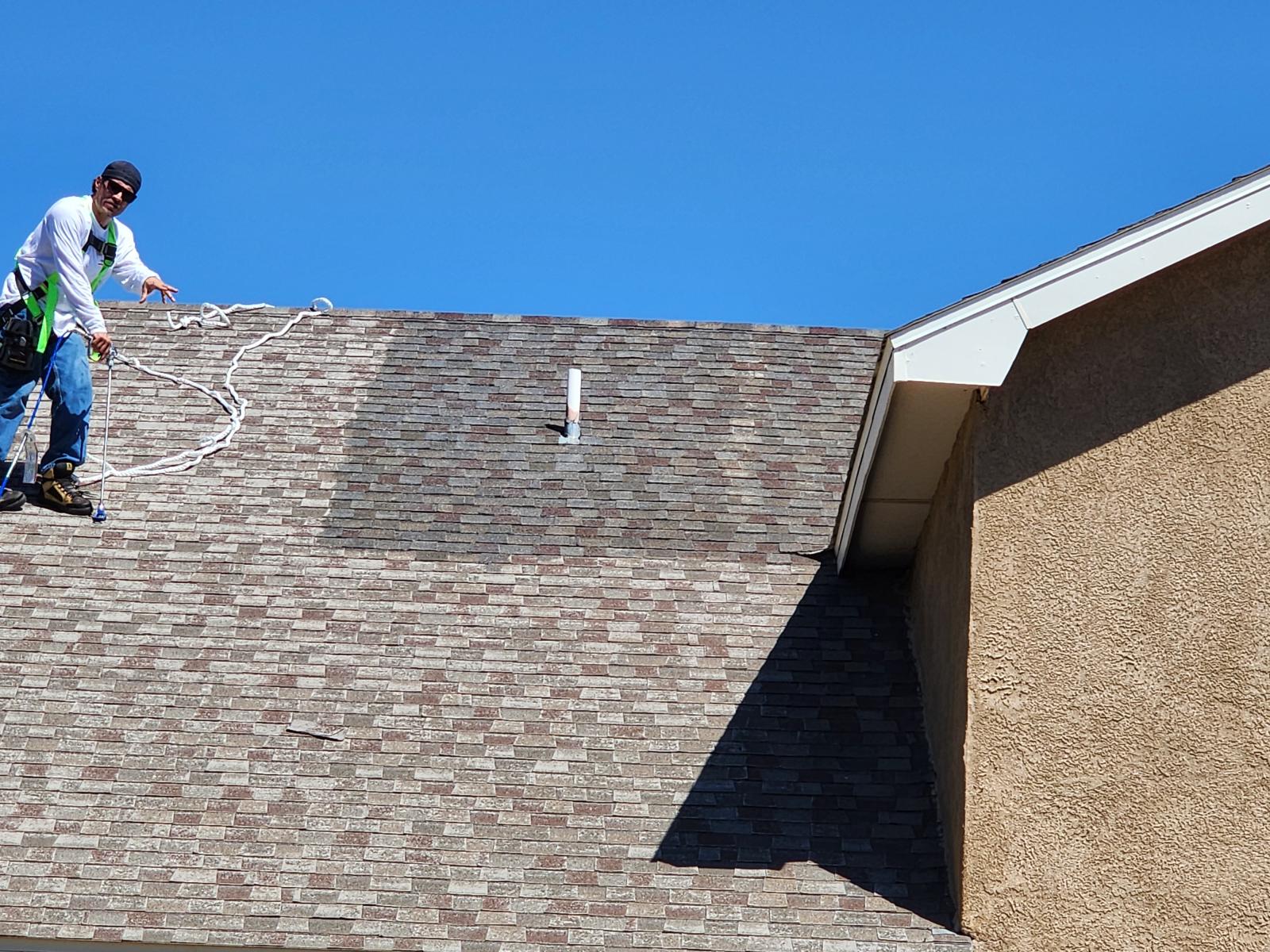
Roof safety equipment for walking on shingles comes down to three things: footwear with real grip, a stable ladder, and fall protection when the roof allows it. None of it makes a steep roof safe. It only lowers the odds of a slip turning into a fall.
What to wear and set up:
- Roofing shoes or soft-soled sneakers. Flat tread, no heels, no bare feet.
- A helmet. It protects your head if you slip near the edge.
- A safety harness and roof anchor. Only useful if you have a solid anchor point.
- A lifeline. It keeps slack short so a slip does not become a fall.
- Gloves. They help your grip on rough granules and tools.
One honest limit: most homes do not have a rated anchor point. Clipping to a vent pipe or chimney is not fall protection. If you cannot anchor properly, treat the roof as unprotected and stay off the steep sections.
What Is a Safe Roof Pitch to Walk On?
A safe roof pitch to walk on is generally a low-slope roof you can stand on without using your hands. Once the slope gets steeper, gravity wins and shoes stop helping. Pitch is usually described as rise over run, inches of vertical rise per 12 inches of horizontal run, and the steeper the ratio, the less safe the surface.
Use this quick guide:
| Roof Pitch (rise per 12 in. run) | Walkability | What to Do |
|---|---|---|
| 2:12 to 4:12 | Generally walkable when dry | Watch for slick spots and loose granules |
| 5:12 to 6:12 | Walkable with care | Keep weight low, move slow, use fall protection |
| 7:12 to 8:12 | Not safe for most homeowners | Call a professional |
| 9:12 and steeper | Never walk | Rope access or lift only |
If you are unsure which category your roof falls into, measure the rise over a known run from the ground, or ask a roofer. A framing square and a level held against the gable end will give you the ratio in a few minutes. Guessing wrong on a steep roof is how people end up sliding toward the gutter.
Pitch is only half the decision. The task matters just as much:
- Gutter cleaning or a visual check. Stay on the ladder and use a reach tool or binoculars. There is no reason to walk the field of the roof for this.
- A small repair or flashing check. Limit yourself to the low-slope section near the eave and keep a spotter on the ground.
- A full inspection or anything near the ridge. Hire a professional. The upper third of a 6:12 roof is where most homeowner slips happen.
- Solar or satellite work. These require rated anchors and manufacturer-approved mounting points. Do not improvise.
Watch out: a roof that looks flat from the street can still be a 5:12 or 6:12 once you are on it. Measure before you climb, not after.
How to Keep From Sliding Off a Roof
Keeping from sliding off a roof starts with three habits: stay low, move slow, and keep your weight over your feet. Slip risk climbs fast on wet shingles, loose granules, and shaded slopes that stay damp. Dry conditions are your friend.
Try these habits every time:
- Walk up and down the slope, not across it. Sideways steps invite a slide.
- Keep your body low. Bend your knees and stay close to the surface.
- Move one foot at a time. Plant, test, then shift your weight.
- Avoid the wet roof. Morning dew and after-rain shingles are slick.
- Stay back from the roof edge. Granules near the edge are often loose.
A common mistake is rushing the last few feet near the gutter. That is exactly where shingles are worn and grip is weakest. Slow down there, not speed up.
Most guides stop there. The part they skip is what happens when a slip turns into a slide, and that is where planning pays off:
- Set a spotter before you climb. Someone on the ground with a phone, who knows your plan and can call for help, is the single cheapest safety upgrade you can make.
- Agree on a check-in. A shout or text every few minutes confirms you are upright. Silence is the signal to act.
- Plan your exit. Know which ladder, which eave, and which direction you will move if the roof gets slick. Do not figure it out mid-slide.
- If you start to slide, spread out. Lie flat, spread your arms and legs, and aim your feet at the gutter rather than fighting the slope. Fighting a slide is how people roll off the edge.
- After a fall, do not jump up. Check for pain in the back, neck, and hips, and let the spotter call for help. Moving a injured person the wrong way causes more harm than the fall.
Watch out: a spotter who is inside or on a phone call is not a spotter. Give them one job and keep them in sight of the roof.
Ladder Setup and Getting On the Roof Safely
Ladder setup decides more roof outcomes than anything else. A ladder that is too short, set too steep, or resting on soft ground will move when you step off it. Get this part right and the climb is far less risky.
Follow these steps:
- Set the feet on firm, level ground. No mud, no loose gravel.
- Extend the ladder past the eave. You want a handhold above the roof line.
- Match the angle. A safe ladder leans at roughly a four-to-one ratio.
- Tie off the top when you can. It stops the ladder from shifting.
- Use three points of contact. Two hands, one foot, then switch.
- Step onto the roof, not over the gutter. Swing wide and plant your foot on solid shingles.
Watch out: resting a ladder against a gutter alone can bend it or let the ladder kick out. If the gutter feels loose, fix it before you climb. For the maintenance items worth checking from the ground first, see our guide to asphalt shingle maintenance.
Step Placement and Balance on Shingles
Step placement and balance on shingles come down to walking gently and spreading your weight. Walk on the lower, flatter part of each shingle where it overlaps, not on the exposed edge. Move deliberately, keep your steps short, and never pivot on one foot.
A few rules that keep you steady:
- Place feet flat, not on tiptoe.
- Step where shingles lie flat and tight.
- Keep your center of gravity over your feet.
- Use your arms for balance, not for carrying.
- Carry tools in a bag, not your hands.
A common mistake is carrying a bucket in one hand. It throws off your balance and leaves you one hand short. Set tools down, move, then pick them up.
When to Skip the Climb and Call FRESH TEC LLC
Some roofs should never see a homeowner's footsteps.
Our FRESH ROOF TREATMENT uses patented, plant-based GreenSoy™ Technology to restore asphalt shingles and driveways, extending their lifespan by 6-8 years at a fraction of replacement cost. Realtors and property managers trust us to get exteriors show-ready before a listing.
If you are unsure whether your roof needs work, start with the facts. Our guide on what a roof inspection checks walks through what a thorough inspection looks at and how those findings decide between rejuvenation, maintenance, or replacement. Wondering whether it is worth the cost? We break that down too.
You do not have to guess whether your roof is safe to walk on or ready for restoration. FRESH TEC LLC offers roof rejuvenation, flat roof coatings, gutter cleaning, and solar panel maintenance, all with eco-friendly products and a warranty that stands behind the work.
Frequently Asked Questions
Is it okay to walk on roof shingles at all?
Yes, with conditions. A few careful steps on a healthy asphalt shingle roof in mild, dry weather will not ruin it. The risk climbs with heat, age, and steepness. Damage depends on temperature, so a roof that tolerates a spring inspection may be brittle and fragile on a 95-degree afternoon. Stay off granule-bare, curling, or soft-feeling shingles and let a professional handle those.
Can a 300lb person walk on a roof?
Weight matters less than where it lands. Asphalt shingles spread load across the deck, but a heavy person concentrating force on one foot near a valley or overhang stresses the material more. Step flat-footed, keep weight over structural members where you can, and avoid the roof edge. If you are unsure about the deck condition, have a roofer inspect first. For heavier homeowners, calling a pro is the safer call.
What roof pitch is safe to walk on?
Most guidance treats a low-slope roof, roughly 4:12 or flatter, as walkable for a careful homeowner in dry conditions. Anything steeper raises slip risk fast, and many roofers treat 6:12 and above as harness-only territory. On a steep roof, use roof anchors and a safety harness or stay off it. When in doubt, treat the pitch as too steep and call a professional.
Can I walk on my roof to clean the gutters?
You can reach gutters from a ladder without stepping onto the shingles at all, and that is the safer choice. If you must go up, work from the lowest, flattest section, keep three points of contact on the ladder, and never lean out over the edge. Book a free inspection if you are unsure.