 How-to
Choosing a Solar Panel Cleaning Company: A Buyer's Guide
Last Updated: November 11, 2026
Quick Summary
To choose a solar panel cleaning company, ask for proof of liability insurance covering roof work, a written cleaning method naming the tools and water pressure used, and written warranty terms for damage during service. A reputable provider also documents existing panel damage with dated photos before cleaning starts.
- Ask for liability insurance, a written method, warranty terms, a clear scope, and local references.
- Jesse Silkoff of MyRoofingPal told ConsumerAffairs the general rule is cleaning every six months.
- A pre-clean inspection photographs glass, cells, frames, mounting hardware, and the roof deck.
- Stop the job if you find cracked panels, lifted frames, loose hardware, exposed wiring, or scorching.
- A safe method uses soft bristles, low pressure, deionized water, and early-day work without standing on glass.
Table of Contents
- What a Solar Panel Cleaning Service Should Prove Before You Hire
- Spotting Solar Panel Damage Before Cleaning Starts
- How Cleaning Methods and Tools Cause Damage
- When a Solar Panel Cleaning Kit Is the Right Call
- How to Clean Solar Panels on Roof Without Ladder Access
- Solar Panel Damage Repair: What Comes After the Inspection
- Book a Free Inspection With FRESH TEC LLC
- Frequently Asked Questions
What a Solar Panel Cleaning Service Should Prove Before You Hire
Choosing a solar panel cleaning company starts with proof, not promises. Ask for insurance, a written method, and warranty terms before anyone climbs on your roof.
The stakes are real. The global solar panel cleaning market was valued at USD 1.54 billion in 2026 and is projected to reach USD 2.34 billion by 2031, according to Mordor Intelligence market forecast.
Here's what a reputable solar panel cleaning service should hand over without hesitation:
- Proof of liability insurance covering roof work
- A written cleaning method that names the tools and water pressure used
- Warranty terms in writing for any damage caused during service
- A clear scope of what gets cleaned and what doesn't
- References from local jobs, not stock photos
Questions to Ask About Method, Insurance, and Warranty
Ask direct questions and listen for specific answers. Vague replies are a warning sign.
- "What water pressure do you use on panel glass?"
- "Do you use brushes, and what are the bristles made of?"
- "Are you insured for roof access and water damage?"
- "What happens if a panel cracks during cleaning?"
- "How often do you recommend cleaning in this climate?"
A company that can't answer these plainly is guessing. Solar panel cleaning is not complicated, but it does require care. Jesse Silkoff, Founder at MyRoofingPal, told ConsumerAffairs that "the general rule for solar panel maintenance is to have them cleaned every six months." A good provider will tailor that schedule to your soiling conditions, not quote it like a script.
Spotting Solar Panel Damage Before Cleaning Starts
Damage should be documented before a single drop of water hits the glass. A careful provider walks the array first and photographs existing cracks, chips, and discoloration.
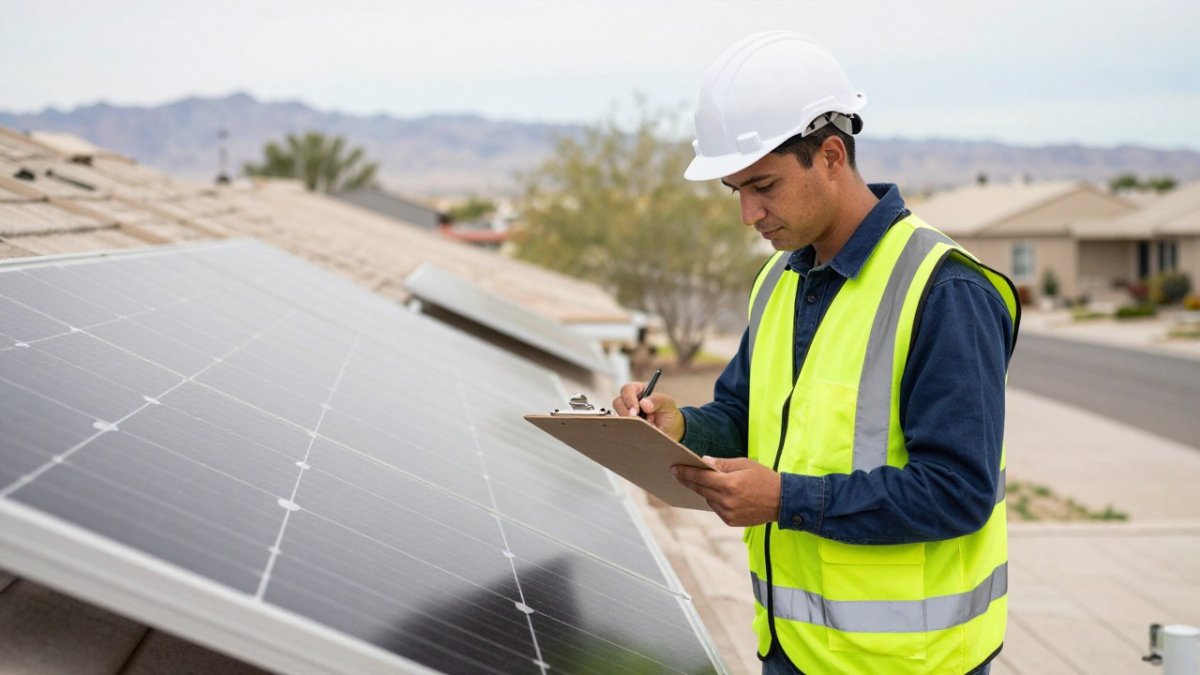
A useful pre-clean inspection follows a fixed order: glass first, then cells, then frames, then mounting hardware, then the roof deck below the array.
A Symptom-by-Symptom Diagnostic Flow
Most guides stop at "look for cracks." The harder and more useful skill is connecting what you see to what probably caused it. Use this flow during the walk-through:
- A straight-line scratch, often clustered in one direction points to an abrasive brush or a dry scrub. It is surface damage to the glass and does not wash out.
- A spiderweb or star-shaped crack radiating from a point points to impact, such as a thrown rock, hail, or a tool dropped on the glass. Thermal shock usually produces a longer, cleaner crack that runs along a cell line rather than radiating from a point.
- White, chalky spots that reappear in the same pattern after rinsing point to mineral deposits or hard-water residue. These are often removable with deionized water; if the pattern survives a deionized rinse and feels etched to the touch, the glass may be permanently stained.
- Brown or blackened discoloration in the center of a cell, sometimes with a visible burn ring points to cell failure or a hot spot, not soiling. No cleaning fixes it.
- A brown or discolored halo around the frame edge often points to seal or encapsulant failure, which lets moisture in and is a warranty matter, not a cleaning matter.
Telling Soiling Apart From Permanent Damage
Soiling washes off. Damage does not. That is the simplest test, and it is the one most homeowners get wrong.
Dust, pollen, bird droppings, and leaves all sit on the surface and rinse away with the right method.
A practical field test: rinse a small area with deionized water and a soft cloth, let it dry, and look again from a low angle in direct light.
If a provider promises to "restore" a cracked panel, walk away.
Stop-Work and Escalation Criteria
A structured checklist is only useful if it tells you when to stop. Most practitioners set clear lines:
- Stop the job if you find a cracked or chipped panel, a lifted frame, loose mounting hardware, exposed wiring, or any sign of arcing or scorching at a connector.
- Do not touch panels, wiring, junction boxes, or roof equipment if you are not qualified. Observation from the ground is the homeowner's role; anything on the roof is the provider's.
- Escalate to the installer or a licensed electrician for cell discoloration, hot spots, inverter fault codes, or any output drop that persists after cleaning.
- Escalate to the manufacturer's warranty process for seal failure, delamination, or cell defects, using the dated photo set and the cleaning history as evidence.
Watch out: a provider who keeps cleaning after finding a cracked panel, or who offers to "seal" a crack with a coating, is creating a liability problem for you and a warranty problem for the array.
How Cleaning Methods and Tools Cause Damage
The wrong tools scratch glass and break seals. Our guide to the best tools for solar panel maintenance covers what safe equipment looks like.
Knowing how each method damages a panel helps you judge a provider's equipment list before they arrive.
| Method or tool | How it damages the panel | What you would see afterward |
|---|---|---|
| High-pressure washer | Forces water past frame seals and junction-box gaskets; can lift edge seals | Moisture inside the frame, fogging under glass, seal failure |
| Abrasive or stiff-bristle brush | Grinds grit across the glass; leaves micro-scratches that scatter light | Fine parallel scratches, dull patches, haze in direct sun |
| Dry scrubbing | Drags dust and grit into the surface instead of lifting it | Scratches that appear only after the panel dries |
| Harsh chemicals or solvents | Attacks frame anodizing, sealant, and backsheet; can void warranties | Stained or chalky frames, brittle seals, discolored backsheet |
| Cold water on hot panels | Thermal shock from rapid temperature change across hot glass | Long cracks along cell lines, sometimes a sharp pop sound |
| Hard tap water left to dry | Leaves mineral film that bakes on in sun | White spotting that returns in the same pattern |
| Standing or kneeling on panels | Point loads crack cells and bend frames | Microcracks, hot spots, output drop with no visible surface mark |
The MDPI review A Review on Solar Panel Cleaning Systems and Techniques examines these cleaning approaches and their drawbacks in detail.
What a Safe Method Looks Like
A safe method is boring, and that is the point. A safe method typically uses soft bristles or a microfiber head, low pressure, deionized or filtered water, work done early in the day before panels heat up, and no standing on the glass.
Watch out: a crew that arrives at midday in summer with a pressure washer and a stiff deck brush is the exact combination that produces thermal-shock cracks and scratched glass.
When a Solar Panel Cleaning Kit Is the Right Call
A DIY kit makes sense for light soiling on a safe, accessible roof. Homeowners can clean panels themselves as an alternative to professional service, with limits.
A solar panel cleaning kit works well when:
- Your panels sit on a single-story roof you can reach safely
- The soiling is light dust or pollen
- You have soft brushes, a hose, and deionized water
- You can work early in the day before panels heat up
Skip the DIY route if you see cracks, notice a performance drop, or need a ladder to reach the array. Those cases call for a pro.
How to Clean Solar Panels on Roof Without Ladder Access
You don't climb. You use a reach system or you hire out. Cleaning panels without a ladder means ground-level tools with long reach poles and soft heads, or a professional service that carries its own safe access gear.
For most homeowners, the practical answer is to call a professional, since a solar array rarely sits where a ladder is easy to place.
If you want to try from the ground:
- Use a soft-bristle reach pole with a water feed
- Work in the cool morning hours
- Rinse with low pressure and let gravity do the work
- Never lean a ladder against the panel frame
Solar Panel Damage Repair: What Comes After the Inspection
Repair starts with documentation. If cleaning reveals cracked glass, a failed seal, or a hot spot, the next step is a written report with photos. That report can support a warranty claim or an installer call.
Here's how to handle what you find:
| Finding | Likely Cause | Next Step |
|---|---|---|
| Scratches on glass | Abrasive brush | Document, contact installer |
| Water spots that won't rinse | Mineral deposits | Try deionized water rinse |
| Cracked panel | Impact or thermal shock | Stop cleaning, call for repair |
| Burn marks or hot spots | Cell failure | Inverter check, warranty claim |
| Loose frame or hardware | Mounting wear | Structural inspection |
Document everything with dated photos. Then contact your installer or manufacturer. Most panel warranties cover manufacturing defects, but not damage from improper cleaning. That's why the pre-clean inspection matters so much.
Book a Free Inspection With FRESH TEC LLC
A good cleaning company proves its method, protects your roof, and documents everything. FRESH TEC LLC is a local, veteran-owned team serving homeowners, realtors, and property managers in Albuquerque and Rio Rancho.
Ready to see your options? Book professional solar panel cleaning in 5 steps, or go straight to solar panel cleaning in Albuquerque and Rio Rancho to request service. Our solar panel cleaning pricing guide walks through what to expect.
Get started with FRESH TEC LLC and protect your panels with a cleaning you can trust.
Your panels have been through another dusty season. Don't let buildup steal your output. FRESH TEC LLC offers solar panel maintenance with plant-based GreenSoy™ Technology, a veteran-owned local team, and a 6-year warranty on our work.
Frequently Asked Questions
What should I ask a solar panel cleaning company before hiring?
Ask what method they use on the glass, whether they use deionized water, and how they handle panels that are hot from direct sun. Confirm they carry liability insurance and can show a certificate. Ask whether they inspect for cracks, burn marks, and discolored cells before cleaning and what they do if they find damage. Get the scope in writing, including whether gutter cleaning or mounting hardware checks are included, and ask how they document condition before and after the visit.
How can I tell if a solar panel is damaged or just dirty?
Dirt and residue sit on the surface and shift with rain or a rinse. Damage does not. Look for cracked glass, white spots that stay put after washing, brown or black burn marks, and cells that look discolored compared with their neighbors. Check the inverter for warning lights or error messages and compare daily output against the same period last year. A sudden drop paired with a visible defect points to damage; a gradual slide over dusty months usually points to soiling.
Can cleaning solar panels damage them?
Yes, when the wrong method is used. Cold water on hot panels can cause thermal shock and crack the glass. Abrasive brushes and pressure washers scratch the surface and can force water past panel seals. Harsh chemicals leave residue that blocks sunlight and may harm the frame. A solar panel cleaning service that rinses with deionized water, uses soft tools, and works in cooler hours avoids most of these risks. Ask about each of these before you book.
Does homeowners insurance cover solar panel damage?
Coverage depends on the policy and the cause. Many homeowners policies treat rooftop panels as part of the structure, so damage from hail, wind, or falling debris may be covered, while wear and damage from improper cleaning often is not. Photograph the array before and after any cleaning, keep the contractor's insurance certificate, and call your insurer before filing. Reviewing the policy language with your agent is the only way to know what applies to your situation.