 comparison
Solar Panel Cleaning vs Washing: What Your Panels Need
Last Updated: November 1, 2026
Quick Summary
Solar panel cleaning is the targeted removal of soil, dust, and debris from the panel surface, while washing is the broader application of water across the array. Cleaning removes what blocks light, whereas washing only rinses loose material off the glass.
- A panel can be washed and still be dirty, since washing only rinses loose material.
- Bird droppings and tree sap need targeted cleaning because a plain rinse smears the residue.
- Most homes need a full solar panel cleaning once or twice a year, with spot treatment as needed.
- Panels left without cleaning or rain for 145 days lost just 7.4% of output.
- Skip detergents and pressure washers, and rinse with filtered or deionized water to avoid mineral spotting.
Table of Contents
- Solar Panel Cleaning vs Washing: The Core Difference
- Why the Distinction Matters for Energy Output
- How Often Should Solar Panels Be Cleaned?
- Can You Wash Solar Panels With Water?
- Solar Panel Cleaning Tools That Are Safe on Glass
- Solar Panel Maintenance Tips for Desert Conditions
- Book a Free Solar Panel Inspection
- Frequently Asked Questions
Solar Panel Cleaning vs Washing: The Core Difference
Solar panel cleaning and washing are not the same job, and treating them as synonyms is how homeowners end up with scratched glass or water spots that cut output. Cleaning is the targeted removal of soil, dust, and debris from the panel surface. Washing is the broader application of water across the array.
Here is the distinction that matters: cleaning is about what you remove, and washing is about how you deliver water. A panel can be washed and still be dirty. It can also be cleaned with almost no water at all.
What Cleaning Actually Removes
Cleaning targets the specific contaminants that block light transmission into the solar cells. That means dust films, pollen, bird droppings, leaf litter, and the sticky residue that holds them in place. Bird droppings are the worst offender because they are opaque and often acidic, and they do not rinse away with a light spray.
A proper clean lifts and carries away those solids rather than smearing them across the glass. The goal is a surface that lets sunlight reach the photovoltaic cells without interference.
What Washing Actually Does
Washing applies water, usually with some pressure or flow, to rinse loose material off the array. It handles the easy stuff: settled dust, light pollen, and whatever a breeze dropped overnight. Washing alone struggles with baked-on droppings or a stubborn grime layer.
That is why a wash can look like it worked while your energy yield stays flat. The water ran off, but the light-blocking film stayed put. Washing is a maintenance rinse, not a restoration, it resets the surface between deeper cleans but does not substitute for one.
A Decision Framework by Soil Type
The choice between cleaning and washing should follow the contaminant, not the calendar. Use this as a starting point:
- Dust and light pollen film: A water rinse (washing) is usually enough, and a soft brush pass during the rinse improves results. Frequency follows wind events, not a fixed schedule.
- Bird droppings and tree sap: These need targeted cleaning. Spot-treat the affected panels with a soft brush and clean water; a plain rinse will smear the residue and leave an acidic film behind.
- Salt spray (coastal sites): Salt leaves a hygroscopic film that holds moisture and dust. Rinse thoroughly with clean water and avoid letting salt-laden water dry on the glass; a filtered final rinse helps.
- Industrial and agricultural residue: Oily or sticky fallout bonds to glass and needs a proper clean with a soft brush and, where the manufacturer allows, a mild panel-safe cleaner. Washing alone will not lift it.
- Hard-water minerals: These are a washing problem, not a cleaning one, see the water-quality note below.
Cleaning vs. Washing by Installation Type
The method also depends on where the array sits:
- Rooftop residential arrays: Access and safety drive the decision. A telescoping wand and hose let you wash from the ground or eaves; deeper cleaning may require roof access with a harness. Never lean on the panels or step on the glass.
- Ground-mounted arrays: Easier access makes both cleaning and washing practical, but keep water away from wiring and junction boxes, and watch for mud splash on the lower row.
- Commercial arrays: Large row counts favor a planned wash cycle with targeted spot cleaning on problem rows, and scheduling around production peaks matters more than on a single home.
The right method follows the contaminant on the glass, not the calendar.
| Soil type | Best method | Key note |
|---|---|---|
| Dust and light pollen film | Washing (water rinse) | Soft brush pass during rinse improves results |
| Bird droppings and tree sap | Targeted cleaning | A plain rinse smears residue and leaves acidic film |
| Salt spray (coastal sites) | Rinse thoroughly with clean water | Filtered final rinse helps; avoid salt water drying on glass |
| Industrial and agricultural residue | Proper clean with soft brush | Mild panel-safe cleaner where manufacturer allows |
| Hard-water minerals | Washing problem, not cleaning | Final rinse with filtered or deionized water |
Why the Distinction Matters for Energy Output
Output loss is real, but it is smaller than most sales pitches suggest. Researchers at the University of California San Diego found that panels left without cleaning or rain for 145 days during a summer drought lost just 7.4% of their output, according to the UC San Diego study on cleaning economics.
That number should reframe how you think about frequency. A modest soiling loss does not justify aggressive scrubbing every month. It does justify removing the heavy, localized soiling that concentrates on a few panels and drags down the whole string.
Cleaning and washing affect output differently. Washing restores a little light transmission across the whole array. Cleaning removes the hot spots, the droppings and grime patches that create uneven production. If you want the deeper performance breakdown, read our article on whether solar panel cleaning improves efficiency.
How Often Should Solar Panels Be Cleaned?
Most homes need a full solar panel cleaning once or twice a year, with spot treatment on problem panels as needed. Dusty desert conditions can call for more frequent attention. Rain helps, but it is not a substitute for a proper clean.
The honest answer is that frequency should follow soiling, not the calendar. Watch for visible dust films, droppings, and pollen crust after windy weeks. If your monitoring shows a slow production dip that does not match the weather, that is your cue.
For a detailed schedule by season and site condition, see our guide on how often solar panels should be cleaned.
Can You Wash Solar Panels With Water?
Yes, water is safe for solar panels when you use it correctly. Plain, clean water with a soft brush is the standard recommendation, and it is what most manufacturers expect. The variables that matter are water quality, delivery pressure, surface temperature, and what the manufacturer's manual actually says.
Water Quality and Mineral Spotting
Tap water is not neutral. Hard water carries dissolved calcium and magnesium that stay behind when the water evaporates, leaving mineral spotting on the glass. Those spots look like soiling and cut light transmission the same way, and over time they can etch into the surface if they are allowed to bake on repeatedly.
A common pattern is that a homeowner washes the array, sees it look worse a day later, and assumes the panels are still dirty. They are not; they are spotted. The fix is a final rinse with filtered or deionized water, which carries away the minerals instead of depositing them.
Pressure, Temperature, and Detergent Cautions
The problems start with how the water is delivered and when. Cleaning in the morning or early evening is generally sensible because panels get very hot during the day, and cold water splashed on hot glass can stress the panel surface.
Skip detergents and abrasive soaps. Residue attracts more dust, and harsh cleaners can damage anti-reflective coatings. Skip the pressure washer too. High-pressure water can force past seals and scratch glass. A garden hose, a soft brush, and patience will outlast any shortcut.
Check the Manufacturer's Guidance First
Before you wash, read the panel manufacturer's cleaning instructions and your warranty terms. Manufacturer manuals typically govern which cleaning methods are approved, so checking them before you wash is important (Solar Panel Cleaning for Homeowners).
For the full tool list and technique, see our guide on the best tools for solar panel maintenance.
Solar Panel Cleaning Tools That Are Safe on Glass
Safe tools share one trait: they lift debris without abrading the glass. Everything else is a gamble.
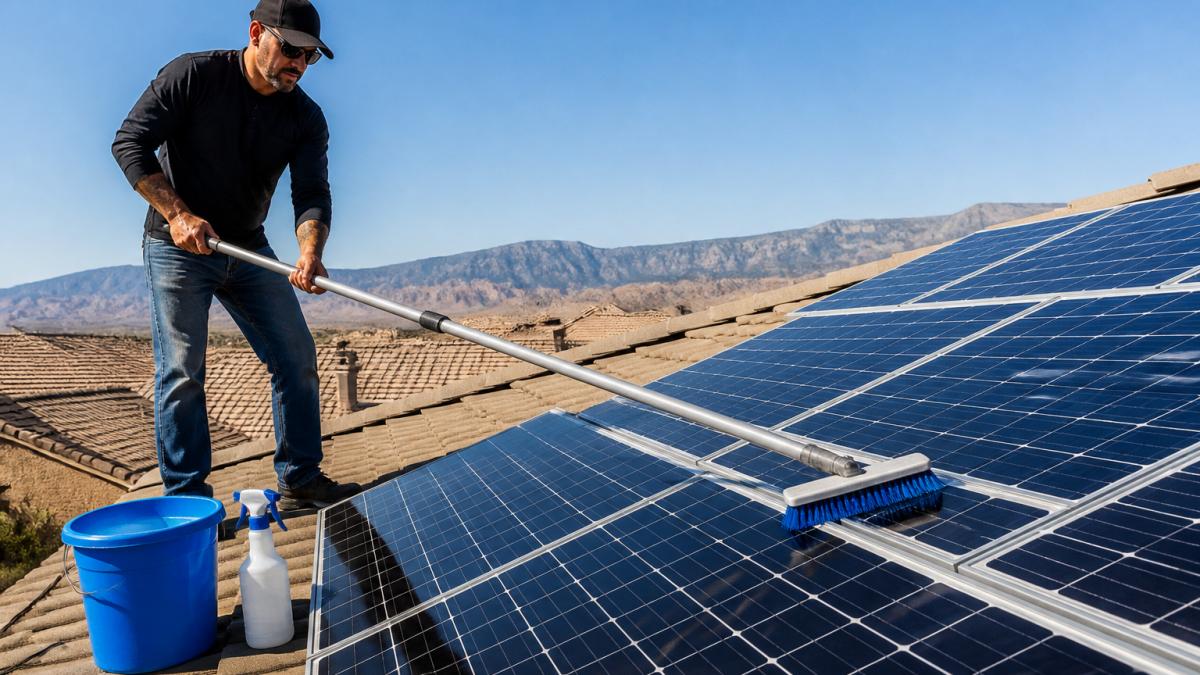
- Soft brush with natural or soft synthetic bristles for agitating dust and droppings
- Telescoping wand to reach roof-mounted arrays without leaning on the panels
- Clean water and a simple hose for rinsing, not blasting
- Microfiber cloth for edges and frames
- Safety harness and non-slip footwear for roof access
What most guides miss is the water itself. Hard water leaves mineral spotting that looks like soiling and cuts light transmission just the same. If your tap water is mineral-heavy, a final rinse with filtered or deionized water prevents the spots from forming.
Solar Panel Maintenance Tips for Desert Conditions
Dust is the defining challenge here, and it arrives faster than rain can clear it. A few habits keep a desert array productive.
- Clean in the morning or early evening, never at midday heat.
- Inspect after every wind event and spot-clean the dirtiest panels.
- Check mounting hardware and wiring annually for sun damage.
- Trim nearby branches that drop debris onto the array.
- Rinse with filtered water to avoid mineral spotting.
Watch out: rinsing a hot array with cold water can crack stressed glass, and that damage is not covered as a cleaning issue. Cool conditions first, water second.
Book a Free Solar Panel Inspection
Cleaning versus washing comes down to what is actually on your panels, and that is a judgment call worth making with trained eyes. FRESH TEC LLC provides solar panel maintenance across Albuquerque and Rio Rancho, backed by our veteran-owned team and our plant-based GreenSoy™ approach to exterior care.
You can book solar panel cleaning in Albuquerque and Rio Rancho directly, and contact us for current pricing, since costs depend on the size and access of your system.
Frequently Asked Questions
What is the difference between cleaning and washing solar panels?
Cleaning targets the specific soils that block light: dust film, pollen, bird droppings, and baked-on debris. It uses a soft brush, a squeegee or cloth, and a small amount of water, with the goal of restoring light transmission. Washing is a broader rinse-down that moves loose dirt off the glass. A wash alone leaves the stubborn film behind, so panels look better but output stays flat. In practice, most arrays need cleaning, and only a light wash between deeper services.
Is it safe to wash solar panels with water?
Yes, with two conditions. Use clean water rather than hard water high in minerals, which dries into spotting that blocks light, and never splash cold water on hot panels. Cleaning in the morning or early evening is generally sensible because panels get very hot during the day, and cold water on hot glass can stress the surface. A garden hose on a cool panel is fine. A pressure washer is not, because high-pressure water can force past seals and damage cells.
How often should solar panels be cleaned?
There is no universal schedule, and frequency should follow measured output rather than the calendar. University of California San Diego researchers found panels left without cleaning or rain for 145 days during a summer drought lost 7.4% of output, so a modest loss accumulates slowly. Check your monitoring app for a gradual dip against the same month last year. In dusty, high-pollen areas, an annual cleaning plus spot treatment of bird droppings is a reasonable starting point.
Can dirty solar panels reduce energy production?
Yes, but usually less than homeowners expect. Soiling can reduce output over time, though usually by a modest amount. The bigger risk is localized soiling: a single bird dropping or a leaf cluster shading one panel can drag down a whole string.
Should you clean solar panels yourself or hire a professional?
Ground-mounted and easily reached arrays are reasonable DIY projects with a soft brush, a hose, and cool conditions. Rooftop arrays are a different calculation: fall risk, electrical components, and panel warranties all matter. Manufacturer instructions typically specify approved methods, so it is worth checking them before cleaning. Professional solar panel maintenance also includes a performance inspection, which is where most homeowners find the real value.
Your panels do not need more water. They need the right treatment at the right time. Get started with FRESH ROOF TREATMENT and keep your array producing at its best.