 listicle
The Best Tools for Solar Panel Maintenance
Last Updated: October 31, 2026
Quick Summary
The best tools for solar panel maintenance are a soft flagged brush, a telescoping or water-fed pole, a deionized water system, and a squeegee or microfiber cloth. Add a multimeter and thermal imager for diagnostics, plus fall protection before any roof work.
- Dirty panels can lose 5% to 25% of output, and dust storms push losses to 40% to 60%.
- Skip stiff or heavy-duty brushes; baked-on grime needs mild soap and a second pass.
- Never use a pressure washer, since seals and glass do not tolerate it.
- Clean early morning or on a cool, overcast day to avoid thermal shock.
- Proactive maintenance saves homeowners an estimated $150 to $300 per year.
Table of Contents
- Why the Right Solar Panel Cleaning Tools Protect Your Investment
- The Core Solar Panel Cleaning Tools Every Kit Needs
- The Best Way to Clean Solar Panels Without Damaging the Glass
- How Often Should Solar Panels Be Cleaned in a Desert Climate?
- Inspection and Diagnostic Tools That Catch Problems Early
- Safety Gear and Working-at-Height Equipment
- Your Solar Panel Maintenance Checklist for Every Season
- Book a Free Inspection With FRESH TEC LLC
- Frequently Asked Questions
Why the Right Solar Panel Cleaning Tools Protect Your Investment
Dirty panels can lose 5% to 25% of their energy output, and dust storms can push that loss to 40% to 60%, according to Energy Solutions' 2026 soiling data. For the evidence on how dirty panels can actually cause system failure, see Can Dirty Solar Panels Cause System Failure?.
Below, we break down the tools that actually earn a spot in your kit, how to use them without damaging the glass, and where a professional crew beats DIY.
The Core Solar Panel Cleaning Tools Every Kit Needs
Every effective solar panel cleaning kit rests on four items: a soft brush, a telescoping or water-fed pole, a deionized water system, and a squeegee or microfiber cloth for finishing. Everything else is an upgrade. Industry guides for 2026 point to water-fed poles, soft brush heads, DI filtration, and portable tanks as the essentials, per EquipMaxx's 2026 equipment guide.
What separates a kit that works from one that damages glass is not the number of tools, it is whether each tool matches your array type, roof height, and water quality. Use the criteria below to choose rather than browse.
Soft Brushes and Non-Abrasive Scrubbers
A soft-bristled brush with flagged filaments is one of the most important purchases you can make. The bristles flex over grit instead of dragging it across the anti-reflective coating. Skip anything labeled "stiff" or "heavy duty." Baked-on grime needs a second pass with mild soap, not a harder brush.
When comparing brushes, check four things: bristle material (natural or soft synthetic, never metal or stiff nylon), filament flagging (split tips trap grit instead of scraping), head width (wider heads cover more glass per pass but are harder to control on steep pitches), and compatibility with your pole's threaded fitting. A brush that does not lock firmly to the pole is a scratch waiting to happen.
Telescoping Poles and Water-Fed Systems
Water-fed pole systems let you clean roof-mounted panels from the ground. A pure water filtration setup removes the dissolved minerals that cause spotting. Together they solve the two biggest residential problems: reach and water spots.
Selection criteria that matter more than brand:
- Reach versus control. A pole long enough to clear a two-story roof is also heavy and whippy at full extension. Measure the horizontal and vertical distance to the farthest panel, then add two feet of margin. Carbon-fiber poles cost more but flex less than aluminum at length.
- Pole-to-brush connection. Threaded metal fittings outlast push-fit plastic ones, which loosen and drip.
- Water-fed compatibility. If you plan to run purified water through the pole, confirm the pole is rated for pressurized flow and that the brush head has a flow-through design.
Squeegees, Microfiber, and Finishing Tools
A squeegee with a fresh rubber blade and a set of microfiber cloths finish the job without streaks. Replace squeegee rubber when it nicks or hardens, and wash microfiber separately from lint-producing fabrics. These are the cheapest items in the kit and the easiest to neglect.
Matching Tools to Your Array Type
The right kit depends on where the panels are:
| Array type | Priority tools | Why |
|---|---|---|
| Single-story rooftop | Soft brush, short pole, garden-hose rinse, squeegee | Reach is manageable; water spots are the main risk |
| Two-story or steep rooftop | Water-fed pole, DI filtration, ground-level access | Keeps you off the roof and solves spotting |
| Ground-mounted | Soft brush, hose, microfiber, cobweb duster | Easy access; focus on debris at frame edges |
| Large commercial array | Water-fed pole system, portable tank, DI cart, inspection camera | Volume and consistency matter more than portability |
The Best Way to Clean Solar Panels Without Damaging the Glass
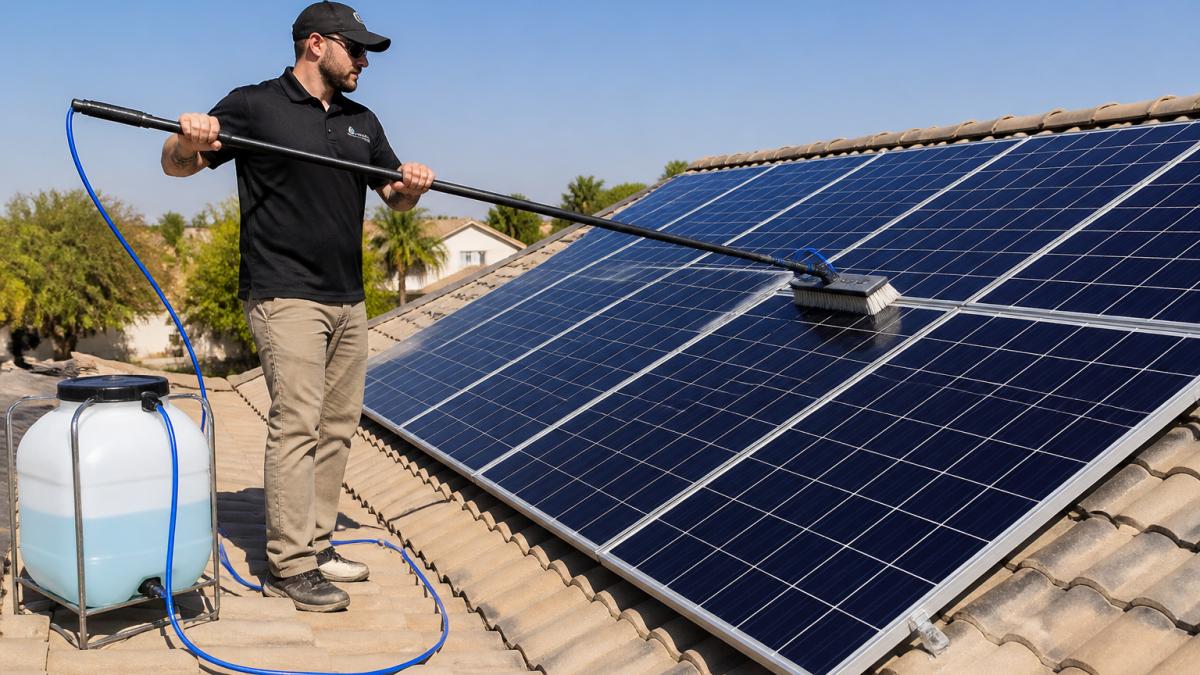
A soft brush, purified or deionized water, and gentle rinsing, worked from the top of the array down, is a common approach to cleaning panels without damaging the glass. A 2025 r/solar discussion flagged high-pressure washing as a direct cause of panel damage, and we agree: the seals and glass do not tolerate it.
Here is the sequence we follow:
- Rinse loose dust and debris off the panel surface first
- Apply a mild, eco-friendly cleaning solution where grime has bonded
- Scrub with the soft brush in straight passes, never circles on dry glass
- Rinse with deionized water to prevent water spots
- Pull a squeegee or wipe with a microfiber cloth for a streak-free finish
Watch out: cleaning panels hot from a full day of sun can thermal-shock the glass. Work early morning or on a cool, overcast day.
How Often Should Solar Panels Be Cleaned in a Desert Climate?
Solar panels in a desert climate often benefit from cleaning several times per year, with an extra pass after any significant dust event. For a deeper breakdown, our guide on solar panel cleaning frequency walks through seasonal timing in detail.
Polling and organic debris matter as much as dust. Cobwebs under the array, bird droppings on the glass, and leaf litter at the frame edges all cut output and trap moisture.
Inspection and Diagnostic Tools That Catch Problems Early
Diagnostic tools turn maintenance from cleaning into prevention, and this is the part of a maintenance kit most cleaning-focused guides skip entirely. Cleaning restores output; inspection finds the problems cleaning cannot fix.
What Each Diagnostic Tool Actually Does
- Multimeter. Measures open-circuit voltage and operating current at the array and at the inverter. A string reading noticeably below its siblings points to a failed panel, a bad connector, or a blown fuse. A basic clamp meter handles current checks without disconnecting wiring.
- Thermal imager. Detects hot spots, cells or connections running hotter than their neighbors. A hot cell often signals internal failure or a cracked cell that will drag down the whole string. Thermal scans are most revealing under load on a sunny day, and they are the fastest way to find a problem the eye cannot see.
- Solar power meter (irradiance meter). Measures incoming sunlight so you can separate a dirt-related dip from a hardware fault. If irradiance is normal and output is low, the problem is in the array, not the weather.
Professional-grade multimeters and thermal imagers are widely used by technicians, while a basic clamp meter can cover many residential needs.
How to Use Them Without Getting Hurt
Diagnostic work involves live DC electricity, and DC arcs do not self-extinguish the way AC arcs do. Safe practice means:
- Measure at the inverter first to confirm the array is producing before you touch anything.
- Never open a junction box or disconnect a connector under load unless you are trained and using rated gloves and tools.
- Treat every conductor as live; panels produce voltage whenever light hits them, and there is no single shutoff for the array side.
- Photograph readings and label strings so a future inspection can compare against a baseline.
The Homeowner's Practical Version
For most homeowners, the practical diagnostic routine is simpler than the tool list: watch your inverter app, note any unexplained drop, and get a professional inspection when the numbers do not recover after cleaning. A common pattern is a slow decline that cleaning does not reverse, that is the signal to bring in a technician with a thermal imager and a meter.
This is where 2026's shift toward predictive maintenance matters. Analytics tools now flag underperformance early enough to schedule a repair instead of a replacement, per SunHub's 2026 predictive maintenance guide. The global solar operations and maintenance market hit $7.16 billion in 2026 and is projected to reach $10.83 billion by 2030, according to Research and Markets, which tells you how seriously the industry now treats monitoring.
Connecting Diagnostics to Your Maintenance Schedule
Diagnostics are only useful if they are tied to a schedule and a baseline. Log production monthly, scan thermally once a year, and meter strings whenever output drops without an obvious cause. That combination catches most failures while they are still cheap to fix.
Safety Gear and Working-at-Height Equipment
Roof safety gear is not optional, and it is the item most DIY kits leave out entirely. Fall protection, a stable ladder rated for the load, non-slip shoes, and gloves belong in the budget before any pole or brush.
Before you climb, settle the roof question. Our article on solar panel maintenance versus roof replacement explains how roof condition should shape your maintenance plan, because cleaning around failing shingles is wasted effort.
Your Solar Panel Maintenance Checklist for Every Season
A solar panel maintenance checklist keeps the work consistent and catches small issues before they get expensive. Proactive maintenance, including regular cleaning and monitoring, saves homeowners an estimated $150 to $300 per year, according to NuWatt Energy's 2026 maintenance guide. Here is the schedule we recommend:
| Task | Frequency | Tool Needed |
|---|---|---|
| Visual inspection for cracks, droppings, debris | Monthly | Eyes and a camera |
| Production check against baseline | Monthly | Inverter app |
| Full cleaning | 2-4 times per year | Soft brush, water-fed pole, DI water |
| Cobweb and frame debris removal | Each cleaning | Cobweb duster |
| Thermal or professional inspection | Annually | Thermal imager or pro service |
| Mounting and wiring check | Annually | Professional |
One more habit worth building: log your production after every cleaning. Over a season, that record tells you whether your cleaning schedule is actually working or just habitual.
Book a Free Inspection With FRESH TEC LLC
Cleaning is the easy part. We provide solar panel cleaning in Albuquerque and Rio Rancho, removing dust and buildup so your panels can perform at their best.
If you would rather hand off the ladder and the pole entirely, our walkthrough on booking professional solar panel cleaning shows exactly what to expect. FRESH TEC LLC is a local, veteran-owned business.
Frequently Asked Questions
What tools do you need to clean solar panels?
A basic solar panel maintenance kit includes a soft-bristled brush, a telescoping or water-fed pole, a squeegee, microfiber cloths, and a deionized water filtration system. For ground-level cleaning, add a portable water tank with a pump. Avoid abrasive pads and high-pressure washers, which can scratch the anti-reflective coating or damage panel seals.
Can you clean solar panels with a garden hose?
A garden hose works for a light rinse, but tap water leaves mineral deposits that cause spotting and reduce light transmission. For a streak-free result, use purified or deionized water through a filtration system. If you rinse with a hose, follow with a squeegee or microfiber cloth to remove water before it dries.
How often should solar panels be cleaned?
In dusty desert climates, panels often need cleaning periodically, with an extra cleaning after dust storms. Dirty panels can lose a meaningful share of energy output. Check your performance monitoring app for output drops to time cleanings accurately.
What should you avoid using to clean solar panels?
Skip high-pressure washers, abrasive scrubbers, and harsh chemical cleaners. High-pressure water can force moisture past panel seals and damage the glass, while abrasive materials scratch the anti-reflective coating. Stick to soft brushes, mild eco-friendly soap, and purified water to protect the panel surface and keep your warranty intact.
Do solar panels need special cleaning equipment?
Yes, the panel surface is delicate glass with an anti-reflective coating, so specialized gear matters. Soft-bristled brushes, water-fed poles, and DI filtration systems are designed to clean without scratching or leaving residue. Professional solar panel maintenance services carry this equipment and the safety gear needed for roof work, which reduces the risk of damage or injury.
Your panels lose output quietly, a few percent at a time, until a dust storm or a failed cell makes the loss obvious. FRESH TEC LLC closes that gap with professional solar panel maintenance, eco-friendly methods, and a 6-year warranty behind the work. Get started with FRESH TEC LLC and book a free inspection to see exactly where your array stands.