 how-to
Does Solar Panel Cleaning Improve Efficiency?
Table of Contents
- Does Solar Panel Cleaning Actually Improve Efficiency?
- How Environmental Factors Affect Solar Panel Output
- How to Clean Solar Panels Safely
- Solar Panel Maintenance Guide for Long-Term Performance
- Professional Solar Panel Cleaning Cost vs. DIY
- How Often Should You Clean Solar Panels?
- Monitoring System Integration for Performance Tracking
- Frequently Asked Questions
Last Updated: September 26, 2026
Does Solar Panel Cleaning Actually Improve Efficiency?
Solar panels lose efficiency when dirt, dust, and debris accumulate on their surface. Does solar panel cleaning improve efficiency? Yes, but the real question is whether the improvement justifies the cost and effort for your specific situation.
Most homeowners see modest gains. A dusty panel might operate at 85-90% capacity instead of full output. Clean panels restore that lost performance. However, rainfall naturally cleans panels in many regions, making professional cleaning unnecessary unless you live in a dry climate or near industrial areas.
FRESH TEC LLC. helps property owners in Albuquerque and Rio Rancho assess whether their solar systems actually need cleaning based on local environmental factors. The answer depends on three variables: your climate, your panel tilt angle, and your monitoring data.
Here's what you need to know before calling a professional.
How Environmental Factors Affect Solar Panel Output
Environmental pollutants are the main culprit behind efficiency loss. Dust, pollen, bird droppings, and atmospheric particulates settle on panel surfaces and block solar irradiance from reaching the photovoltaic cells. However, not all soiling is equal, the type, duration, and composition of deposits determine whether rainfall will clean them naturally or whether professional intervention is necessary.
Common contaminants and their impact:
- Fine dust and sand particles, Easily removed by rain; typical soiling loss 2-5% per month in arid regions
- Pollen buildup, Sticky and weather-resistant; can reduce output 5-8% in high-pollen seasons
- Bird droppings and residue, Create localized shading and acidic corrosion; can reduce output 10-15% in affected areas
- Industrial emissions and fallout, Adhere strongly to glass; typical loss 3-6% in industrial zones
- Mineral deposits from hard water spray, Create permanent micro-shading and cannot be removed without risking panel damage; loss varies 2-4% depending on water hardness
Hard water mineral buildup: a critical maintenance nuance
When panels are cleaned with hard tap water or exposed to mineral-rich spray (coastal salt spray, agricultural irrigation overspray, or recirculated HVAC condensate), calcium, magnesium, and silica deposits bond to the tempered glass surface. Unlike dust or pollen, these minerals form a crystalline layer that does not dissolve in water and cannot be scrubbed without scratching the anti-reflective coating, which itself reduces light transmission by 1-3% permanently.
If your area has water hardness above 200 parts per million (ppm), or if you live within 2 miles of the coast or agricultural operations, hard water mineral buildup becomes a limiting factor in cleaning frequency. Professional cleaning using deionized water prevents this damage, but DIY cleaning with tap water can actually worsen efficiency over time through repeated mineral layer buildup.
Regional climate impact on soiling and cleaning frequency
Your location determines both the rate of soiling loss and whether natural rainfall is sufficient:
Arid and semi-arid regions (Southwest, Great Plains): Dust storms and low rainfall mean panels accumulate 15-25% soiling loss within 4-6 weeks. Professional cleaning 3-4 times yearly is typical. Example: Phoenix-area systems average 18% efficiency loss before seasonal cleaning.
Coastal regions (Atlantic, Pacific, Gulf): Salt spray creates adhesive deposits and mineral buildup. Rainfall is frequent but often insufficient to remove salt residue. Cleaning 2-3 times yearly recommended. Hard water mineral deposits are a secondary concern here.
Agricultural areas (Midwest, Central Valley): Pollen and dust from field operations create sticky soiling. Spring and fall peaks require targeted cleaning. Cleaning 2 times yearly typical. Irrigation overspray can introduce hard water minerals.
Humid subtropical and tropical regions (Southeast, Hawaii): Frequent heavy rainfall naturally cleans panels, but high humidity accelerates algae and mold growth on panel edges. Cleaning 1 time yearly or as-needed. Mineral buildup is less common due to rainfall frequency.
Temperate regions with moderate rainfall (Northeast, Pacific Northwest, Upper Midwest): Natural rainfall handles most soiling. Cleaning annually or every 18 months is sufficient unless panels are shaded by trees or near industrial sources.
Your tilt angle and system orientation
Steeper panels (45+ degrees) shed debris more easily than flat-mounted systems. South-facing panels accumulate soiling faster than east or west-facing orientations because they receive more direct sunlight and heat, which can bake dust and pollen onto the surface. Flat roofs accumulate 20-30% more soiling loss over time compared to pitched installations.
Rainfall effectiveness: the incomplete solution
Light rain (under 0.25 inches) does not fully clean panels, it may actually redistribute dust into streaks. Heavy downpours (over 0.5 inches) work better, but mineral-rich water can leave residue. In regions with hard water, even heavy rain leaves a thin mineral film that reduces light transmission by 1-2%. This is why monitoring your system's output after rain events reveals whether natural cleaning is sufficient for your specific location and water quality.
How to Clean Solar Panels Safely
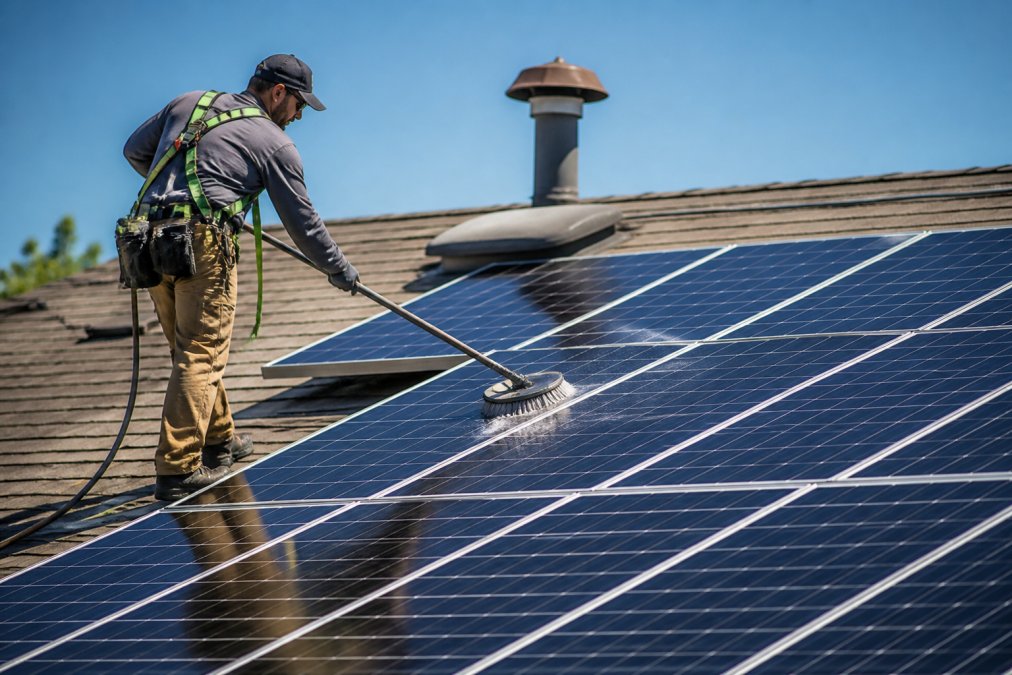
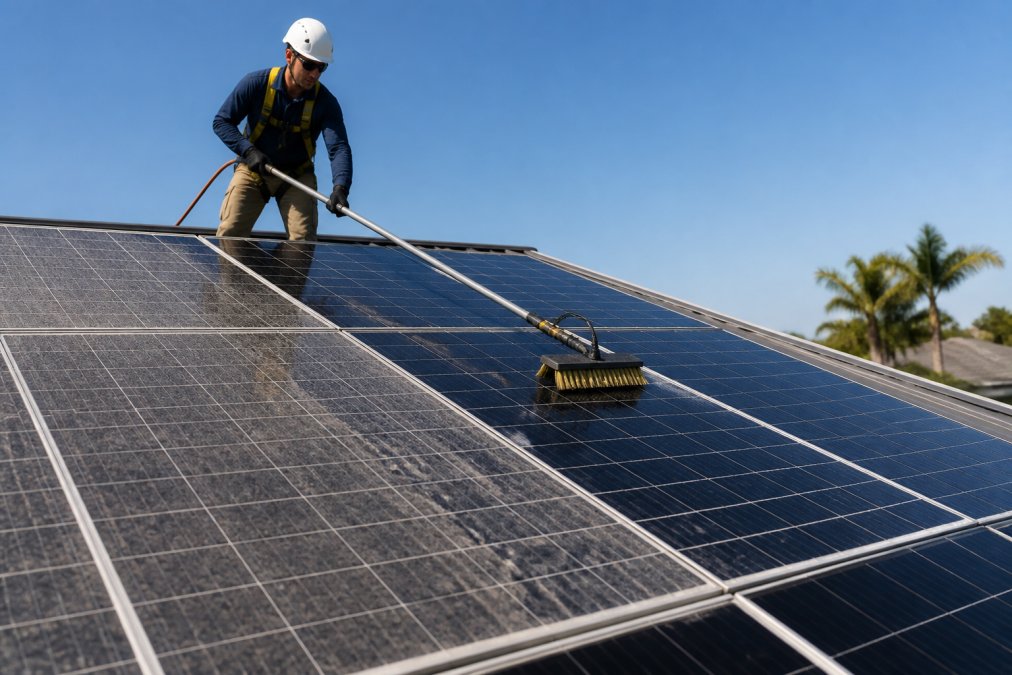
Cleaning solar panels yourself is possible but risky. Roof work requires proper safety equipment and technique. One slip costs far more than professional cleaning. Beyond fall hazards, improper cleaning tools can cause permanent damage to your panels through micro-cracking, hairline fractures in the silicon cells that reduce energy output gradually and may not be visible until performance monitoring reveals the loss.
Safety precautions for DIY cleaning:
- Use a safety harness rated for roof work
- Wear non-slip footwear with good grip
- Never use abrasive materials that scratch panels
- Avoid pressure washers, they damage seals and can cause micro-cracking
- Work on cool mornings to prevent thermal shock
- Never stand directly on panels
Cleaning equipment: what works and what doesn't
Pressure washers are the most common mistake. Water jets above 1,500 PSI can force water behind the panel frame seals, causing internal corrosion and electrical faults. They also create thermal stress when hot panels are suddenly cooled, leading to micro-cracking in the silicon substrate. Avoid them entirely.
Soft-bristle brushes (natural horsehair or nylon, not synthetic) paired with a low-pressure garden hose spray work well. The bristles should be softer than the tempered glass surface, harder bristles scratch the anti-reflective coating and reduce light transmission. Microfiber cloths are effective for light dust but require more manual effort on larger systems.
Deionized water is essential if your tap water is hard. Mineral-rich water leaves deposits that create permanent shading. These deposits (calcium, magnesium, silica) bond to the glass and cannot be removed without damaging the panel surface. If you must use tap water, squeegee immediately after rinsing to minimize mineral residue.
Extensible poles with soft brush heads allow you to clean from the ground on low-pitch roofs, eliminating roof access entirely for many residential systems.
Basic cleaning steps:
- Turn off your inverter before starting
- Use a soft-bristle brush or microfiber cloth with deionized water
- Spray gently across the surface, never use a nozzle setting that creates a hard stream
- Avoid harsh chemicals, vinegar, or soap residue (soap leaves a film that reduces light transmission)
- Let panels air-dry completely
- Restart your system once dry
When to call a professional
Solar Panel Maintenance Guide for Long-Term Performance
Cleaning is just one part of panel maintenance. System longevity depends on monitoring, seasonal care, and addressing problems early.
Annual maintenance checklist:
- Inspect panels for cracks or micro-cracking
- Check that mounting hardware remains tight
- Clear debris from gutters near panels
- Verify inverter is functioning normally
- Review energy production trends month-to-month
Professional Solar Panel Cleaning Cost vs. DIY
The cost-benefit analysis depends on your energy production and local labor rates. The cost of professional cleaning depends on system size and roof complexity.
When professional cleaning makes sense:
- Your roof is steep or multi-level
- You're uncomfortable with heights
- Your system shows measurable output degradation
- You live in a high-soiling area
- Your warranty requires professional maintenance
When DIY is reasonable:
- Your roof is low-pitch and easily accessible
- You have proper safety equipment
- Your panels are showing only light dust
- You're comfortable with basic maintenance tasks
How Often Should You Clean Solar Panels?
Cleaning frequency depends on your environment and monitoring data. There's no universal schedule that works everywhere.
High-soiling areas need cleaning 2-4 times yearly:
- Desert regions with frequent dust storms
- Areas near agricultural operations
- Industrial zones with emissions
- Locations with heavy bird activity
Moderate-soiling areas need cleaning 1-2 times yearly:
- Suburban neighborhoods
- Areas with seasonal pollen peaks
- Regions with occasional dust events
Low-soiling areas may need cleaning annually or less:
- Coastal areas with regular rainfall
- Regions with frequent heavy rain
- Forested areas with good drainage
Monitoring System Integration for Performance Tracking
Your inverter monitoring system is your best tool for deciding whether cleaning is necessary. Modern inverters track kilowatt-hour production and can alert you to performance drops.
What to monitor:
- Daily energy production compared to historical averages
- Performance ratio (actual output vs. expected output)
- Seasonal trends and weather impacts
- Sudden drops that indicate soiling or damage
Frequently Asked Questions
Does solar panel cleaning really make a difference in energy output?
Yes. Soiling loss from dust, pollen, bird droppings, and atmospheric debris can reduce energy production by 15-25% depending on your climate and environmental conditions. Regular cleaning restores system efficiency and kilowatt-hour output. The impact is most significant in dry climates with infrequent rainfall, where mineral buildup and debris accumulation occur faster. Monitoring your inverter output helps you detect when cleaning will provide the greatest return on investment.
How often should I clean my solar panels to maintain peak performance?
Most homeowners benefit from cleaning twice yearly, though frequency depends on your local environment. Dry, dusty regions or areas with heavy pollen require more frequent maintenance. If you live near agricultural areas, industrial zones, or experience bird droppings, quarterly cleaning may be necessary. Use inverter monitoring to track performance ratio changes; a sudden drop signals that cleaning is overdue. Rainfall helps naturally clean panels, so rainy climates may need less frequent professional attention.
Is it safe to clean solar panels myself or should I hire a professional?
DIY cleaning is possible but carries roof safety risks. If your panels are low-pitched or easily accessible from the ground, you can use a soft-bristle brush and deionized water to avoid thermal shock and micro-cracking. Never use abrasive materials or high-pressure water. For rooftop installations, hire a professional, roof work requires proper safety equipment, fall protection, and knowledge of electrical hazards. Professional cleaners understand panel warranty requirements.
What is the cost-effectiveness of professional solar panel cleaning?
Professional cleaning costs depend on system size, roof accessibility, and your location. Compare the cleaning cost against your monthly energy savings using inverter data. In high-soiling environments, regular professional maintenance extends panel lifespan and maintains warranty compliance. Request a free inspection to assess your specific system's cleaning needs and potential energy recovery.