 how-to
How to Protect Asphalt Shingles from Desert Sun Damage
Last Updated: October 22, 2026
Quick Summary
Protect asphalt shingles from desert sun damage by combining balanced roof ventilation, reflective cool-colored shingles or coatings, and twice-yearly inspections that catch granule loss and cracking early. These steps slow UV breakdown and heat cycling, the two forces behind desert sun damage.
- Inspect your roof twice a year, plus after monsoon season, and photograph and date what you find.
- Check for blocked soffit vents before spending money on any other cooling step.
- Ask for a product's rated solar reflectance and thermal emittance before you commit to reflective shingles.
- Trim trees, keep gutters clean, and fix small cracked shingles fast before they become leaks.
- Document inspections and keep receipts, since many shingle warranties require proof of proper maintenance.
Table of Contents
- Why Desert Sun Chews Through Asphalt Shingles
- Signs of Heat Damage to Shingles You Should Not Ignore
- How to Inspect an Asphalt Shingle Roof Safely
- Roof Ventilation in Hot Climates: The Cooling Step Most Homeowners Skip
- Reflective Shingles for Hot Climates: Do They Really Help?
- A Desert-Specific Maintenance Schedule to Prevent Sun Damage
- Repair, Rejuvenate, or Replace: Weighing Your Options
- Conclusion
- Frequently Asked Questions
Why Desert Sun Chews Through Asphalt Shingles
Learning how to protect asphalt shingles from desert sun damage starts with one fact: your roof never gets a cloudy season. We see the same pattern on roof after roof.
Why? Two forces work together.
Ultraviolet radiation breaks down the asphalt that holds each shingle together. The National Institute of Standards and Technology has studied how UV exposure and related conditions degrade shingle covers over time.
Heat adds a second problem. Dark shingles soak up solar radiation and push attic temperatures higher. Then evening cools the roof fast.
Insurance Institute for Business & Home Safety research shows that age, climate, roof orientation, and shingle sealing all affect long-term performance.
Signs of Heat Damage to Shingles You Should Not Ignore
Spotting the signs of heat damage to shingles early is the difference between a small fix and a full replacement. Watch for these:
- Granule loss. Bare, dark patches where the mineral surface has worn away.
- Curling shingles. Edges that lift or cup away from the roof deck.
- Cracked shingles. Splits that appear as the asphalt dries out and loses flexibility.
- Blistering. Small raised bubbles caused by trapped moisture and heat.
- Fading or discoloration. Uneven color, often worst on south- and west-facing slopes.
Granule loss matters most. Those granules shield the asphalt from the sun's rays. Once they wash away, UV exposure speeds up fast.
How to Inspect an Asphalt Shingle Roof Safely
Knowing how to inspect an asphalt shingle roof without risking a fall is step one. Most of the work happens from the ground and from inside the attic, not on top of the roof. A structured, two-pass inspection also helps you tell sun damage apart from wind, hail, or installation defects, which matters for both repair decisions and insurance claims.
Pass 1: Ground-level walkaround
Walk the full perimeter with binoculars, then repeat from a second angle (across the street or from a neighbor's yard if permitted). You are looking for:
- Granule buildup in gutters, at downspout outlets, and in the gravel strip at the base of the walls. Heavy granule accumulation is one of the clearest early signals of surface breakdown.
- Color banding on south- and west-facing slopes, the slopes that take the longest direct sun.
- Curled, cupped, or lifted edges, especially along ridges, hips, and rake edges.
- Dark patches or bare spots where the mineral surface has worn through.
- Ridge cap condition, ridge caps weather first because they sit at the hottest, most exposed point.
Pass 2: Attic inspection (the step most homeowners skip)
From inside the attic, with a flashlight, look for:
- Daylight through the roof deck, a sign of open seams or fastener pops.
- Water staining or dark streaks on rafters and sheathing.
- Soft or spongy decking when pressed gently (use a screwdriver handle, not your hand).
- Discolored or crushed insulation near the eaves, which can signal blocked soffit vents.
- Heat staining, brownish discoloration on the underside of the deck, which points to poor ventilation rather than a leak.
When roof access is unsafe
Do not walk the roof when any of these apply:
- Surface temperatures are high enough to soften shingles underfoot (common on summer afternoons).
- The roof pitch is steep, or the roof is more than one story with no safe tie-off.
- Shingles are visibly soft, curled, or missing.
- There is any moisture, morning dew, or wind.
A single-story, low-slope roof can sometimes be checked from a stable ladder at the eave, feet on the ladder, hands on the rails, never stepping onto the roof itself. For anything else, call a qualified roofer. A fall costs far more than an inspection.
Symptom-to-cause guide: sun vs. wind vs. hail vs. installation
| What you see | Most likely cause | How to tell |
|---|---|---|
| Even granule loss on sun-facing slopes | Sun/UV aging | Gradual, worst on south/west, no impact marks |
| Torn, creased, or missing tabs in patterns | Wind | Directional tearing, lifted edges on windward slopes |
| Round bruises, cracked mat, dented soft metals | Hail | Circular impact marks, often with granule splash rings |
| Curling along a straight line or at fasteners | Installation defect | Consistent pattern tied to nailing or deck seams |
| Blisters with trapped moisture | Heat + moisture | Raised bubbles, often on older shingles |
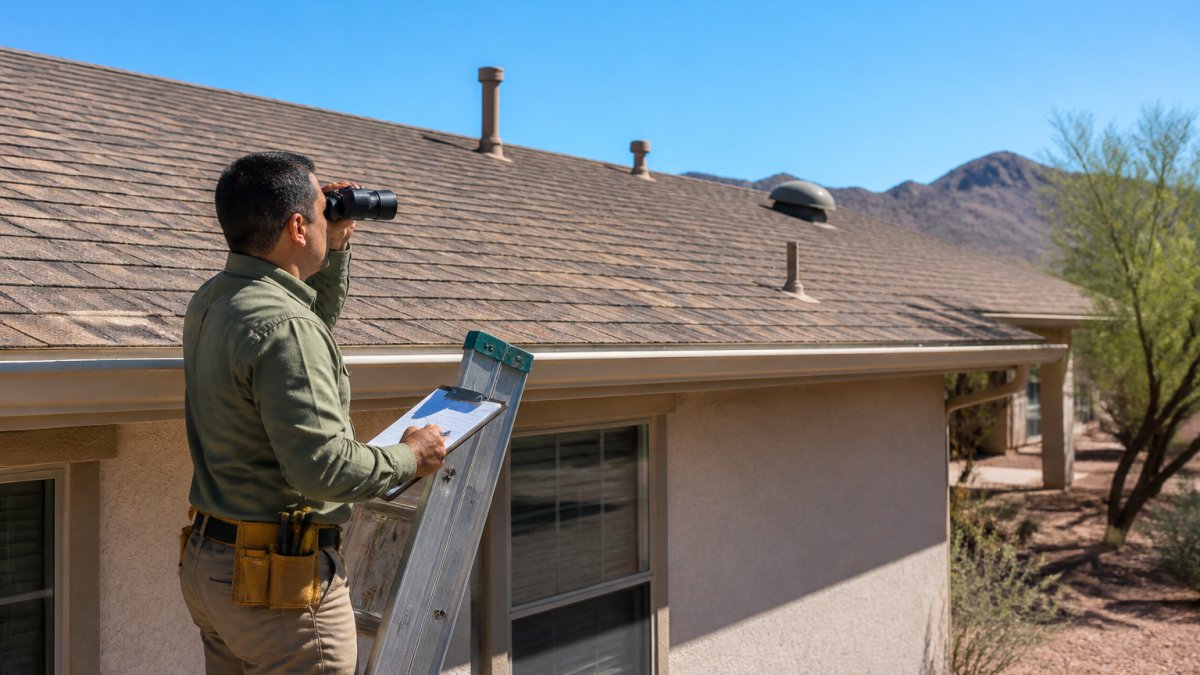
Do this inspection twice a year, plus after monsoon season. Photograph and date what you find so you can track changes and back up any future claim. Heat damage hides in plain sight until it is expensive.
Roof Ventilation in Hot Climates: The Cooling Step Most Homeowners Skip
Roof ventilation in hot climates is the cheapest way to fight heat buildup, and most homeowners ignore it. A roof that cannot breathe traps hot air in the attic.
The fix is simple in concept:
- Intake vents at the eaves pull in cooler air.
- Exhaust vents near the ridge let hot air escape.
- Balanced airflow keeps the attic closer to outdoor temperature.
Pair good ventilation with attic insulation and you slow the heat cycle that drives thermal shock. A radiant barrier can help too. None of these steps replace sun protection, but together they reduce the load on your shingles.
Reflective Shingles for Hot Climates: Do They Really Help?
Reflective shingles for hot climates do help, but they are not magic. The mechanism is straightforward: cool-colored granules and higher solar reflectance bounce more of the sun's energy back instead of absorbing it as heat. Less absorbed heat means a cooler attic and less thermal stress on the roof deck. The U.S. Department of Energy's cool roof guidance and the ENERGY STAR program both describe solar reflectance and thermal emittance as the two properties that drive how much heat a roof surface sheds.
The two numbers that matter
- Solar reflectance (albedo), the fraction of incoming sunlight reflected away. Higher is cooler.
- Thermal emittance, how efficiently the surface radiates absorbed heat back to the sky (Cool Roofs). Higher is cooler.
A shingle can be strong on one and weak on the other. A product with high reflectance but low emittance still holds heat longer after sunset, which matters in a climate with big day-night temperature swings. Look for both figures on the product data sheet, not just a "cool" label.
Reflective shingles vs. roof coatings
| Option | Best fit | Trade-off |
|---|---|---|
| Reflective (cool-colored) shingles | Full replacement already due | Higher material cost than standard shingles; reflectance fades as granules wear |
| Reflective roof coating | Existing roof in decent shape | Adds reflectivity without tear-off; needs reapplication and surface prep |
| Standard shingles + ventilation/insulation | Budget-constrained, sound roof | Lower upfront cost; relies on attic-side heat control rather than surface reflectance |
When reflective shingles make sense:
- Full replacement is already due. Choose reflective shingles then, not before.
- Your roof faces long sun exposure. South and west slopes benefit most.
- You want lower cooling loads. Reflectivity supports that goal.
Where they fall short: they still age under ultraviolet radiation. They still lose granules. Reflectivity slows the damage, it does not stop it. And reflectance drops as the surface weathers, so the benefit is front-loaded over the shingle's life.
For an existing roof in decent shape, a roof coating can raise reflectivity without a tear-off. FRESH TEC LLC applies flat roof coatings and uses our plant-based GreenSoy™ Technology to restore aging shingles. That treatment can extend roof lifespan by 6-8 years, backed by a 6-year warranty.
A Desert-Specific Maintenance Schedule to Prevent Sun Damage
A simple schedule beats a big repair bill. Here is the rhythm we recommend for desert homes:
| Timing | Task | Why It Matters |
|---|---|---|
| Spring | Full roof inspection | Catch winter wear before summer heat |
| Early summer | Clear debris and check vents | Keep airflow open during peak heat |
| After monsoon season | Inspect for granule loss and cracks | Storm and sun damage compound |
| Fall | Clean gutters and touch up minor repairs | Prep the roof for the next hot season |
Add these habits:
- Trim trees so branches do not shade and trap moisture unevenly.
- Keep gutters clean so water does not back up under shingles.
- Fix minor repairs fast. A small cracked shingle becomes a leak.
Preventive maintenance is cheaper than emergency work every time.
Repair, Rejuvenate, or Replace: Weighing Your Options
Three paths exist, and the right one depends on how far the damage has gone.
Minor repairs fit isolated cracked or curling shingles. Low cost, quick fix, but they do not restore the whole roof.
Rejuvenation fits shingles that are aging but still sound.
Replacement fits widespread granule loss, soft spots, or active leaks. At that point, patching wastes money.
Not sure which applies? Book a free inspection and we will tell you honestly.
Conclusion
Desert sun will test your roof every single day. The homeowners who win are the ones who inspect early, ventilate well, and treat small problems before they grow.
If your shingles are showing their age, FRESH TEC LLC can help. Our veteran-owned team offers eco-friendly roof rejuvenation, flat roof coatings, gutter cleaning, and solar panel maintenance, all backed by an industry-leading 6-year warranty.
Frequently Asked Questions
What ruins asphalt shingles fastest in a desert climate?
Ultraviolet radiation and sustained heat are the biggest threats. UV exposure breaks down the asphalt binder that holds granules in place, while thermal expansion and contraction from temperature swings stress the shingle mat. The Asphalt Roofing Manufacturers Association notes that shingles are built for direct sun after installation, but that does not stop long-term degradation. Granule loss, curling, and cracking are the visible results. Proper attic ventilation, reflective shingles, and regular inspections slow the process.
How can you tell if asphalt shingles have sun damage?
Look for granule loss in gutters and at downspout outlets, shingles that curl at the edges, blisters on the surface, and cracks that run with the shingle grain rather than across it. Sun damage usually shows up on south- and west-facing slopes first. Distinguish it from wind damage, which lifts or tears shingles, and hail damage, which leaves circular dents. A NIST 2026 laboratory study on asphalt shingle degradation under UV and heat conditions supports what inspectors see in the field.
Do reflective shingles help in hot, sunny climates?
Reflective or cool-colored shingles carry granules engineered to bounce more solar radiation back instead of absorbing it. That lowers roof deck temperature and can reduce heat buildup in the attic. The benefit is real but modest on its own; pair reflective shingles with proper roof ventilation and attic insulation to see the full effect. If your roof is still in good shape, a reflective roof coating can add solar reflectance without a full replacement.
How often should asphalt shingles be inspected in a desert climate?
Plan on two inspections a year: one in spring before summer heat peaks and one in fall after monsoon season. Add a check after any major windstorm or hail event. Homeowners can do a safe ground-level and ladder-edge look, but a professional inspection catches deck-level problems, flashing failures, and early shingle deterioration. Catching minor repairs early is far cheaper than a roof replacement.