 comparison
Solar Panel Cleaning Pricing 2026: What to Expect
Table of Contents
- What Solar Panel Cleaning Pricing Looks Like in 2026
- What Affects Your Solar Panel Cleaning Quote
- Residential vs Commercial Solar Panel Cleaning Pricing
- One-Time Cleaning vs Recurring Service Contracts
- How Often Should Solar Panels Be Cleaned?
- Is Solar Panel Cleaning Worth It?
- DIY Solar Panel Cleaning: When It Makes Sense
- Conclusion: Getting the Right Price for Your Panels
- Frequently Asked Questions
Last Updated: October 15, 2026
What Solar Panel Cleaning Pricing Looks Like in 2026
At FRESH TEC LLC, we field questions about solar panel cleaning pricing every week from homeowners who want a straight answer before they book.
Here is the part most guides skip: the number you see online is a benchmark, not a quote.
Yelp's solar panel cleaning cost guide reports an average professional cleaning price of $200, with a flat-rate range of $95 to $350 for panels on a 1,600 to 2,000 square foot house. The same guide lists an average per-panel price of $3.
Two guides, two ranges, same job. Below, we break down why that happens and how to read any quote you receive.
Average Cost and Price Ranges
The national benchmark for a residential cleaning sits between $150 and $350 per visit for a typical 10 to 20 panel system, according to SolarIQ USA's cleaning cost guide. Yelp's data lands in a similar place, with a $200 average and a $95 to $350 flat-rate spread.
| Pricing Model | Published Range | Best For |
|---|---|---|
| Flat rate per visit | $95 to $350 | Average homes, 10-20 panels |
| Per-panel | $3 to $20 per panel | Larger systems, easy roof access |
| Per-panel with minimum | $9/panel, $150 minimum | Small systems where travel matters |
| Commercial base + per panel | $200 base plus $4/panel | Multi-unit and commercial sites |
Per-Panel vs Flat-Rate Pricing Models
Flat-rate pricing charges one price for the visit regardless of panel count within a set range. Per-panel pricing multiplies a rate by the number of panels. Neither is automatically cheaper.
A flat rate rewards larger systems. If you have 24 panels and a cleaner quotes a flat $250, you are paying about $10 per panel. A per-panel quote at $9 would come to $216, so the per-panel model wins. Flip the math: on an 8-panel system, a $150 minimum beats a flat $250 every time.
What Affects Your Solar Panel Cleaning Quote
Four factors move a quote more than anything else: roof height and pitch, access, system size, and local conditions. A cleaner who has to set up fall protection, work around obstructions, or haul water up a ladder prices that labor into the visit.
Roof Height, Pitch, and Access Surcharges
Steep pitches and multi-story roofs slow the work down and require more safety equipment, and that time shows up in the price. Helios Energy Global's guide names system size and roof access as the two main pricing factors, which matches what we see in the field.
Ground-mounted arrays are the cheapest to clean because there is nothing to climb. Single-story roofs come next. Two-story roofs with steep pitch and no walkable surface cost the most, and some companies add a mobilization fee just to bring the equipment out.
Regional Pricing Differences
Location changes the number. Labor rates, travel distances between jobs, and how much dust a region sees all feed into local pricing.
In the Southwest, where dust and pollen settle on panels faster than in wetter climates, cleaners often build more frequent visits into their service plans. That frequency, not the per-visit rate, is what drives your annual spend.
Residential vs Commercial Solar Panel Cleaning Pricing
Commercial cleaning is quoted per site, not per panel, because no two commercial roofs are alike.
That structure makes sense once you see the work. A commercial array may span multiple roof sections, sit behind equipment, or need access coordination with a property manager. A residential roof is one visit, one crew, one price.
For property managers overseeing several buildings, the commercial model usually beats booking separate residential cleanings. One contract, one schedule, one point of contact.
One-Time Cleaning vs Recurring Service Contracts
A one-time cleaning solves a problem today. A recurring contract keeps production steady all year. Which one you need depends on how fast your panels soil.
One-time visits suit homeowners preparing to sell, or anyone who let debris build up and wants a reset. Recurring service, often quarterly, suits properties in dusty areas or near trees. DronePower1's guide notes that commercial work frequently runs on quarterly contracts for exactly this reason.
The pricing math favors recurring service in most cases. Cleaners build predictable routes and pass some of that efficiency back to contract customers, and you avoid the mobilization and minimum charges that hit single visits hardest.
| Service Type | Typical Structure | Best For |
|---|---|---|
| One-time cleaning | Single flat or per-panel charge | Pre-sale prep, post-storm cleanup |
| Quarterly contract | Scheduled visits, commercial or residential | Dusty areas, tree cover, commercial sites |
| Annual cleaning | One visit per year | Mild climates with light soiling |
How Often Should Solar Panels Be Cleaned?
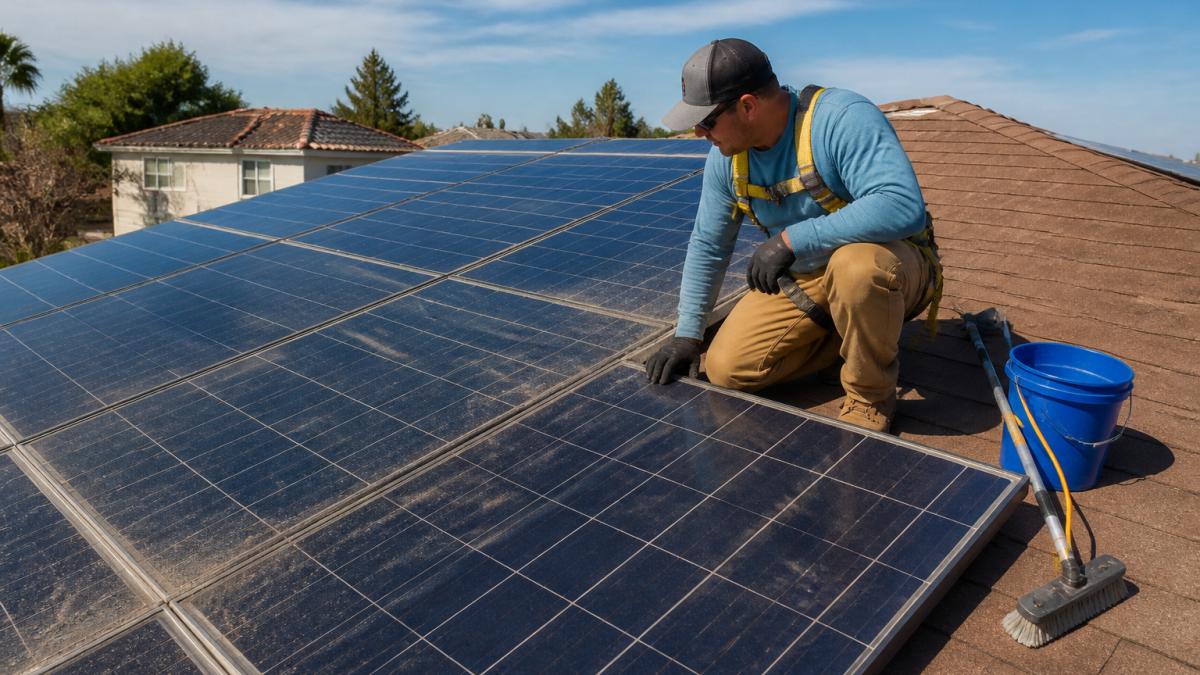
Most homes need a cleaning once or twice a year, while properties in dusty or tree-heavy areas often need quarterly service. Frequency depends on soiling, not the calendar. Rain helps, but it leaves behind mineral deposits and does not clear heavy dust or bird droppings.
Signs it is time to book:
- A visible film of dust or pollen on the glass
- Bird droppings or leaf litter on the array
- A drop in your system's production readings
- Nearby construction or wildfire smoke in recent months
If you are unsure, ask a cleaner to assess the array during a quote. Most will tell you honestly whether you need service now or can wait.
Is Solar Panel Cleaning Worth It?
Cleaning is worth it when soiling is heavy enough to cut production, and it is a waste of money when your panels are already clean. The honest answer depends on your site conditions and how much output you are losing.
Soiled panels produce less. That is not a sales pitch, it is how the equipment works. Dust, pollen, and droppings block light from reaching the cells, and the loss compounds as buildup thickens. the U.S. Department of Energy's solar energy resources explains how photovoltaic systems convert sunlight to electricity, which is the mechanism soiling interferes with.
How to Estimate Your Soiling Loss
You do not need lab equipment to get a usable estimate. Compare your system's current output against a clean baseline using one of these methods:
- Monitoring app comparison. If your inverter or monitoring app shows daily or monthly production, compare a recent clear-sky day against a similar clear-sky day from right after your last cleaning. The gap is your soiling loss.
- Neighbor or array comparison. If you have two arrays or a nearby system of similar size and orientation, compare output on the same day. A persistent gap points to soiling.
- Visual inspection. A visible film, dust ridge along panel edges, or droppings confirm soiling is present, even if you cannot quantify it precisely.
Most residential systems in dusty regions see meaningful losses during dry stretches, while systems in wetter climates with regular rain see much less. Your own monitoring data is a better guide than any national average.
The Payback Calculation
Once you have an estimated loss, the math is straightforward:
- Estimate your lost production in kilowatt-hours over the period between cleanings.
- Multiply that by your electricity rate to get the dollar value of the lost energy.
- Compare that value to the cleaning quote.
If the value of recovered energy exceeds the cleaning cost over the same period, cleaning pays for itself. If it does not, wait until soiling builds further or skip the visit. This is why a cleaning that costs more than the energy it recovers is not worth booking, no matter how dirty the panels look.
When Cleaning Clearly Pays Off
Some situations tip the math decisively toward cleaning:
- Heavy, visible soiling. Thick dust, pollen, or droppings block enough light that the recovered energy usually exceeds the cleaning cost.
- High electricity rates. The more you pay per kilowatt-hour, the more each recovered unit is worth, which shortens payback.
- Large systems. A bigger array loses more total energy from the same percentage of soiling, so the recovered value scales up.
- Post-event cleanup. Wildfire ash, construction dust, and storm debris can cause sharp, sudden losses that justify an immediate visit.
When to Skip It
Cleaning is not worth it when your panels are already clean, when recent rain has washed them, or when your monitoring shows output tracking its normal baseline. Booking a cleaning on a clean array recovers nothing and simply adds cost. If you are unsure, ask a provider to assess the array during a quote, most will tell you honestly whether you need service now or can wait.
DIY Solar Panel Cleaning: When It Makes Sense
DIY solar panel cleaning makes sense for ground-mounted arrays and single-story roofs you can reach safely from the ground with a long-handled pole. It stops making sense the moment you need a ladder on a steep or multi-story roof.
If you go the DIY route, use soft brushes, a squeegee, and plain water or a mild soap. Work in the early morning when panels are cool, since cold water on hot glass can stress the surface.
The real cost of DIY is not supplies, it is risk. Falls from roofs send thousands of people to emergency rooms every year, according to the CDC's fall prevention data, and a solar array adds trip hazards to an already dangerous surface.
Conclusion: Getting the Right Price for Your Panels
Published benchmarks give you a starting point, but the only number that matters is the one on your quote. Compare flat-rate and per-panel offers side by side, ask what the price includes, and check whether a minimum or mobilization fee applies before you commit.
FRESH TEC LLC handles solar panel maintenance alongside roof rejuvenation, gutter cleaning, and flat roof coatings, so one trusted local team covers the whole exterior.
Book a free inspection with FRESH TEC LLC and get a clear, itemized price for your panels before any work begins.
Frequently Asked Questions
How much does solar panel cleaning usually cost?
Your actual price depends on panel count, roof access, and local labor rates, so request an itemized quote before booking.
What should a solar panel cleaning quote include?
A complete solar panel cleaning quote should list the number of panels, the pricing model (per-panel or flat rate), any minimum service charge, and whether travel or mobilization fees apply. Ask whether the price covers roof access surcharges, water access, and post-cleaning inspection. If a quote only gives a total without these details, ask for a written breakdown so you can compare providers fairly.
Can I clean solar panels myself?
DIY solar panel cleaning works for ground-mounted or easily reachable panels. Use a soft brush or squeegee, plain water, and a mild soap if needed. Avoid abrasive tools, high-pressure washers, and harsh chemicals, which can scratch or degrade the panel surface. For roof-mounted systems, especially on steep or high roofs, professional cleaning is safer and protects your warranty.
Is solar panel cleaning worth it?
It depends on how much soiling has built up. In dusty regions, panels can lose a noticeable share of output within weeks without rain. If your system is underperforming and panels look coated, professional cleaning often pays for itself through restored energy production. In areas with regular rainfall, cleaning may only be needed once or twice a year. Compare your output data before deciding.
How often should solar panels be cleaned?
Most homes need cleaning once or twice a year. In dusty or dry climates with little rain, quarterly service keeps production consistent. Commercial systems on large roofs often run quarterly contracts. Check your panels after pollen season, dust storms, or nearby construction. If you notice a drop in energy output and visible soiling, it is time to schedule a cleaning.