 How-to
How to Protect Solar Production from Albuquerque Dust Storms
Last Updated: November 16, 2026
Quick Summary
Albuquerque dust storms cut solar production two ways: cloud cover during the storm and dust left on the glass afterward. Research cited in a 2023 review found a single dust storm can cut module power output by 20%, while long-term dust exposure can reduce it by 50%.
- A 2023 study measured solar radiation dropping as much as 54.5% during dust-storm conditions.
- A 2024 review found dust buildup can cut power by more than 1% per day.
- Compare a clear day after a storm to a clean baseline to isolate soiling loss.
- Rinse panels with plain water first so dust floats off instead of grinding into glass.
- In heavy dust season with low rain, clean every 2-3 months.
Table of Contents
- How Albuquerque Dust Storms Cut Solar Energy Production
- The Effect of Dust on Solar Panel Efficiency
- Why Albuquerque's Desert Conditions Make Panel Soiling Worse
- Solar Panel Production Monitoring: Measuring Your Loss and Recovery
- How to Clean Solar Panels After a Dust Storm
- Solar Panel Cleaning Frequency in a Dusty Climate
- Book a Free Inspection with FRESH TEC LLC
- Frequently Asked Questions
How Albuquerque Dust Storms Cut Solar Energy Production
Dust storms cost Albuquerque homeowners real solar production, and the research shows how. A 2023 review cites a prior report that a single dust storm can cut photovoltaic module power output by 20%, while long-term exposure can reduce it by 50% (review of dust accumulation effects on photovoltaic panels).
Here is the part most guides skip: the drop you notice after a storm is usually two problems stacked on top of each other. One is cloud cover blocking sunlight during the storm. The other is dust left sitting on the glass afterward.
Below, we break down what the research says, how to measure your own loss, and when to call a professional.
What the Research Shows About Airborne Dust and Power Output
Airborne dust blocks sunlight before it ever reaches the panel.
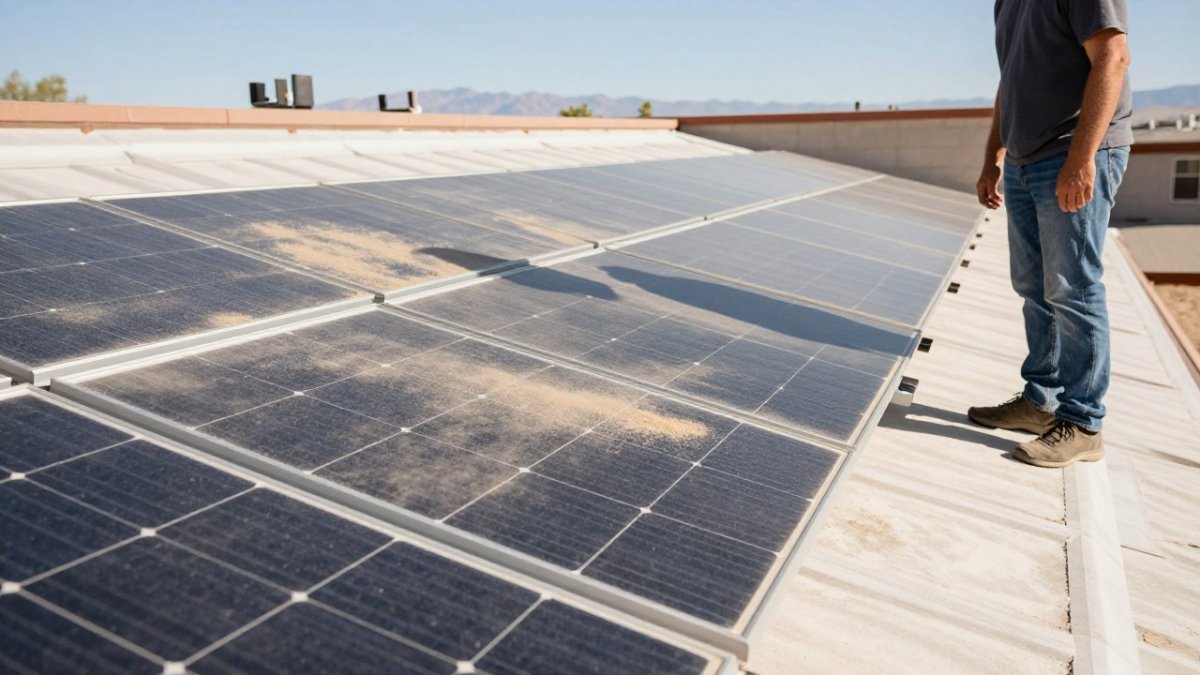
The longer story is deposition. A 2024 review found dust buildup can cut power by more than 1% per day and, depending on conditions, by as much as 80% per month (review of environmental dust accumulation on solar energy systems).
So what does this mean for your roof? A storm hits, output falls fast, then recovers partly on its own as the air clears. The dust that settled stays put and keeps shaving off production day after day.
Reported Solar Power Output Losses from Dust and Storms
Source: PubMed Central, “Effect of dust accumulation on the performance of photovoltaic
The Effect of Dust on Solar Panel Efficiency
The effect of dust on solar panel efficiency comes down to one thing: less light reaching the cells. Dust particles settle on the glass, scatter incoming sunlight, and lower the transmission coefficient. Less light in means less electricity out.
What separates a light dusting from a production-killing coating is not just how much dust lands, but what kind. Fine desert silt behaves differently from coarse sand, and the difference shows up in how fast output falls and how hard the glass is to clean.
Particle Size and Composition
Fine silt and clay particles, the kind that stay airborne longest and travel farthest, are the worst offenders for two reasons. First, they pack tightly into a thin, uniform film that blocks and scatters light across the whole panel rather than in a few spots. Second, they bond to glass more aggressively, especially once morning dew or humidity gives them a chance to adhere.
Composition matters too. Dust high in calcium carbonate and other alkaline minerals can leave a cemented film after it gets wet and dries, which is why a panel that looks lightly soiled can still read a meaningful production loss.
How the Loss Scales
Soiling loss is not linear. A thin, even film causes a disproportionate drop because it scatters light at the glass-air interface before it ever reaches the cells. As the layer thickens, losses compound, and the rate of decline depends on deposition rate, tilt, and how often the surface gets wet.
How much you lose depends on several factors:
- Dust particle size and composition (fine desert silt vs. coarse sand)
- Wind speed during and after the storm
- Humidity and temperature, which help dust stick to glass
- Storm duration and deposition rate
- Panel tilt angle, which affects how much dust settles and how much rain washes off
A University of Texas at El Paso study looked at a dust-prone desert site near White Sands and still found a favorable outlook for solar, with potential for lower maintenance costs (UTEP research on desert dust and solar panels). Dust is a maintenance issue, not a reason to skip solar.
Short-Term Storm Losses vs. Long-Term Buildup
Short-term losses come from the storm passing through: clouds, blown dust, reduced irradiance. These largely clear on their own within hours or days.
Long-term buildup is different. It accumulates quietly across weeks and months. If you never clean, you may never notice the slow slide in daily production because there is no sudden drop to catch your eye. That is why monitoring matters more than memory.
Watch out: assuming a dirty-looking panel is the whole problem. A panel can look hazy and still be producing near its clean baseline, while a panel that looks clean can carry a thin alkaline film that is quietly costing you output.
Why Albuquerque's Desert Conditions Make Panel Soiling Worse
Albuquerque's arid conditions are close to a worst-case setup for panel soiling. Dry air, frequent wind, and fine desert dust mean particles land on glass and stay there. Rain, the cheapest natural cleaner, shows up rarely and unpredictably.
Three local factors drive soiling rates up:
- Wind-driven dust during spring gusts and storm events
- Low humidity, so dust does not clump and blow off as easily
- Sparse rainfall, so panels go long stretches without a natural rinse
Resuspension, where wind lifts settled dust back into the air, helps a little. But it also means more dust is in the air to land again. For a desert climate, plan on cleaning being a regular part of ownership, not a one-time chore.
Solar Panel Production Monitoring: Measuring Your Loss and Recovery
Solar panel production monitoring is how you turn a vague worry into a number. You cannot manage what you do not measure, and you cannot tell storm loss from soiling loss without a baseline. The useful part is separating the two losses, because only one of them justifies climbing onto the roof.
Build a Baseline Before the Storm
Start with these steps:
- Record a clean-panel baseline. Note daily production in kilowatt-hours right after a cleaning, and note the weather that day.
- Log storm dates. Write down when dust events hit your area, along with wind direction and whether rain followed.
- Compare before-and-after output. Look at the same days of the week, same weather where possible.
- Track the performance ratio over a month, not a single day.
- Watch for slow decline between cleanings, which signals soiling rather than weather.
Most monitoring apps show daily and monthly energy yield, so you do not need special equipment. What you do need is a clean-day reference point, because a number without a comparison tells you nothing.
Separating Cloud Loss from Soiling Loss
This is the step almost every guide skips. A storm delivers two hits at once: clouds cut irradiance during the event, and dust left on the glass keeps cutting it afterward. To tell them apart, compare three windows:
- The storm day itself. Output falls sharply. This is mostly cloud and airborne dust, and it should recover on its own.
- The first clear day after the storm. If output is still below your clean baseline on a bright, cloudless day, the gap is soiling.
- The following week. A persistent shortfall that does not close on clear days confirms buildup rather than weather.
A simple way to frame it: if a clear-sky day after the storm produces meaningfully less than a comparable clear-sky day before it, the difference is the dust still sitting on the glass. That is your soiling loss, and it is the number that tells you whether cleaning is worth the effort.
Quantifying Loss and Recovery
You can estimate your loss without lab equipment. Take a representative clear-day production figure from your baseline, then compare it to a clear day after the storm.
A common pattern is a small, steady shortfall that never quite recovers between storms, which is the signature of cumulative buildup rather than a single event.
Watch out: comparing a cloudy post-storm day to a sunny pre-storm day.
If you want the deeper evidence on how much cleaning actually restores, our guide on whether solar panel cleaning improves efficiency walks through it.
How to Clean Solar Panels After a Dust Storm
Cleaning after a dust storm is simple if you follow a few rules. The biggest mistake is scrubbing dry dust across dry glass, which can scratch the surface and leave permanent marks.
Here is the safe sequence:
- Wait for the storm to fully pass and for panels to cool. Never clean hot glass.
- Check for damage first. Look for cracked glass, loose wiring, or lifted frames. If you see any, stop and call a pro.
- Rinse first with plain water to float dust off, not grind it in.
- Use a soft brush or microfiber pad and a mild, non-abrasive cleaner.
- Rinse again and let panels air dry.
- Stay off the roof in high wind or wet conditions, and never walk on panels.
Watch out: skipping the first rinse is the most common cause of micro-scratches, and those do not come out. If you would rather not climb up there, our article on signs of solar panel damage from improper cleaning covers what to check before you decide.
Solar Panel Cleaning Frequency in a Dusty Climate
Solar panel cleaning frequency in a dusty climate depends on your tilt, tree cover, roof pitch, and how often storms roll through. There is no single right number. It depends on your tilt, tree cover, roof pitch, and how often storms roll through.
Use this simple decision guide:
| Your situation | Suggested cleaning rhythm |
|---|---|
| Heavy dust season, low rain | Every 2-3 months |
| After a visible dust storm | Within 2 weeks |
| Average residential setup | 2-3 times per year |
| Noticeable output drop on monitoring | Clean, then recheck |
| Steep tilt, frequent rain | 1-2 times per year |
For a deeper breakdown of timing, our 2026 guide to solar panel cleaning frequency has the full schedule. The main rule: let your monitoring data set the pace, not the calendar.
Book a Free Inspection with FRESH TEC LLC
Storm damage and heavy soiling are hard to judge from the ground. FRESH TEC LLC is a local, veteran-owned team serving Albuquerque and Rio Rancho, and we handle solar panel maintenance as part of our exterior care services.
We also offer solar panel cleaning in Albuquerque to remove dust and buildup so your panels can perform at their best. Not sure what a cleaning should cost? Our 2026 solar panel cleaning pricing guide explains what drives the number before you book anything.
Dust storms will keep coming, and every week of buildup quietly costs you production.
Frequently Asked Questions
How much can Albuquerque dust storms reduce solar panel output?
Research on dust accumulation reports wide ranges depending on conditions. Research on dust accumulation shows that storms and settled dust can visibly cut solar production. Check your inverter's daily numbers before and after the event to see your own system's loss.
How soon should I clean solar panels after a dust storm?
Wait until the storm has fully passed and the panels are dry. Cleaning while dust is still airborne or while the glass is wet from rain risks smearing grit across the surface. Once conditions are clear, inspect for a visible film or caked dust, then clean or schedule service. If your production monitoring shows output still lagging several sunny days later, that is your signal to act rather than wait for the next rain.
Can rain remove dust from solar panels?
Light rain often makes things worse by turning dust into a muddy film that dries in place. A heavy, sustained downpour can rinse away loose dust, but research on dust accumulation shows that rainfall removal is inconsistent and depends on intensity and timing. In a dusty climate, do not count on rain as your cleaning plan. Track output after storms and clean when production stays below your normal baseline.
Is it safe to clean solar panels yourself?
Cleaning from the ground with a soft brush and plain water is low risk. Getting on the roof is the real hazard: falls, damaged panels, and scratched glass are common outcomes for homeowners without fall protection. If your array sits on a steep or tall roof, or the dust is caked on, have a professional handle it. FRESH TEC LLC offers solar panel maintenance as part of its exterior care services, backed by a 6-year warranty.