
 how-to
How to Identify Early Signs of Roof Shingle Granule Loss
Last Updated: October 30, 2026
Quick Summary
To identify early granule loss, inspect from the ground on a dry, overcast day using binoculars, scanning each slope for shiny or smooth patches where asphalt shows through. Also check gutters and downspout splash zones for coarse, sand-like grit, since granules collect where water exits.
- Run a repeatable five-step ground-level inspection that takes ten to fifteen minutes on an average single-story home.
- Never walk a wet, frosty, or mossy roof, since granule loss itself makes the surface slicker.
- Shiny patches are the clearest early clue, because black asphalt shows through where granules wore away.
- Algae streaks run vertically down the slope, while granule loss forms patches that ignore water flow.
- New shingles routinely shed excess granules for the first several rains as manufacturing residue clears.
Table of Contents
- Start With a Safe Ground-Level Roof Inspection for Granule Loss
- What Early Granule Loss Looks Like on Asphalt Shingles
- Finding Granules in Gutters and Downspouts
- Bald Spots on Asphalt Shingles: When Loss Becomes a Problem
- Common Causes of Shingle Granule Loss
- How to Tell Granule Loss Apart From Algae and Staining
- What to Document After a Storm for Insurance or a Contractor
- Book a Free Roof Inspection With FRESH TEC LLC
- Frequently Asked Questions
Start With a Safe Ground-Level Roof Inspection for Granule Loss
Learning how to identify early signs of roof shingle granular loss starts with your feet on the ground, not on the roof. Granule loss is the wearing away of the mineral surface that protects asphalt shingles from sun and rain.
Run a ground-level inspection the same way every time so you can compare findings to last season's and spot a trend.
A Repeatable Five-Step Inspection Sequence
Work through these steps in order. The whole pass takes ten to fifteen minutes on an average single-story home.
- Pick the right conditions. Inspect on a dry, overcast day, or in early morning or late afternoon light. Harsh midday sun washes out color differences, and wet shingles hide texture. Never inspect during or right after rain.
- Walk the full perimeter. Start at the front and move clockwise, stopping at each corner to look up at the slope facing you and the slope facing away.
- Scan each slope in bands. With binoculars, sweep from the ridge down to the eave in horizontal bands roughly the width of your field of view.
- Check the ground and gutters below. Look at the splash zone under each downspout and the gutter run itself. Granules collect where water exits.
- Photograph and note. Take a wide shot of each slope and a close-up of anything that looks off. Write the date and weather conditions on your notes.
What to Look For at Each Step
- Walk the perimeter of your home with binoculars
- Check the roof from at least two angles per side
- Look at the ground below downspouts for grit
A Practical Severity Framework
No published standard sets a universal number of granules per square foot that means "replace the roof." Anyone who gives you a hard threshold is guessing.
| What You Observe | Distribution | Exposed Substrate | Roof Age | Ongoing Shedding | Rough Urgency |
|---|---|---|---|---|---|
| Light grit in gutters, even color | Uniform across slopes | None visible | Under 10 years | Slows after rain | Monitor; recheck in 6 months |
| Patchy fading, some smooth spots | Localized to one slope | Dark asphalt showing | 10-15 years | Continues between storms | Inspect within a season |
| Bald patches, curling edges | Concentrated on one side | Asphalt and mat visible | 15+ years or storm-hit | Heavy after every rain | Professional inspection now |
| Fiberglass threads visible | Widespread | Mat exposed | Any age | Constant | Treat as active failure |
Treat the age column as a rough guide, not a rule. A well-ventilated roof in a mild climate can outlast a poorly ventilated one by years, and a single severe hailstorm can age a roof overnight.
Safe Inspection Boundaries
Never climb onto a steep or wet roof. Ladder falls are a leading cause of home injury, and a fall costs far more than any repair. A few hard boundaries keep the inspection safe:
- Stay off any roof with a pitch steeper than you can comfortably walk on flat ground. Most one-story homes have slopes steep enough to be dangerous without fall protection.
- Never walk a wet, frosty, or mossy roof. Granule loss itself makes the surface slicker, so a worn roof is more hazardous than a new one.
- Skip the ladder entirely if you are alone, if wind is gusting, or if the ladder cannot be set on firm, level ground.
The National Roofing Contractors Association homeowner resources recommend annual inspections and after major storms. A ground-level check takes ten minutes and catches most early warning signs.
What Early Granule Loss Looks Like on Asphalt Shingles
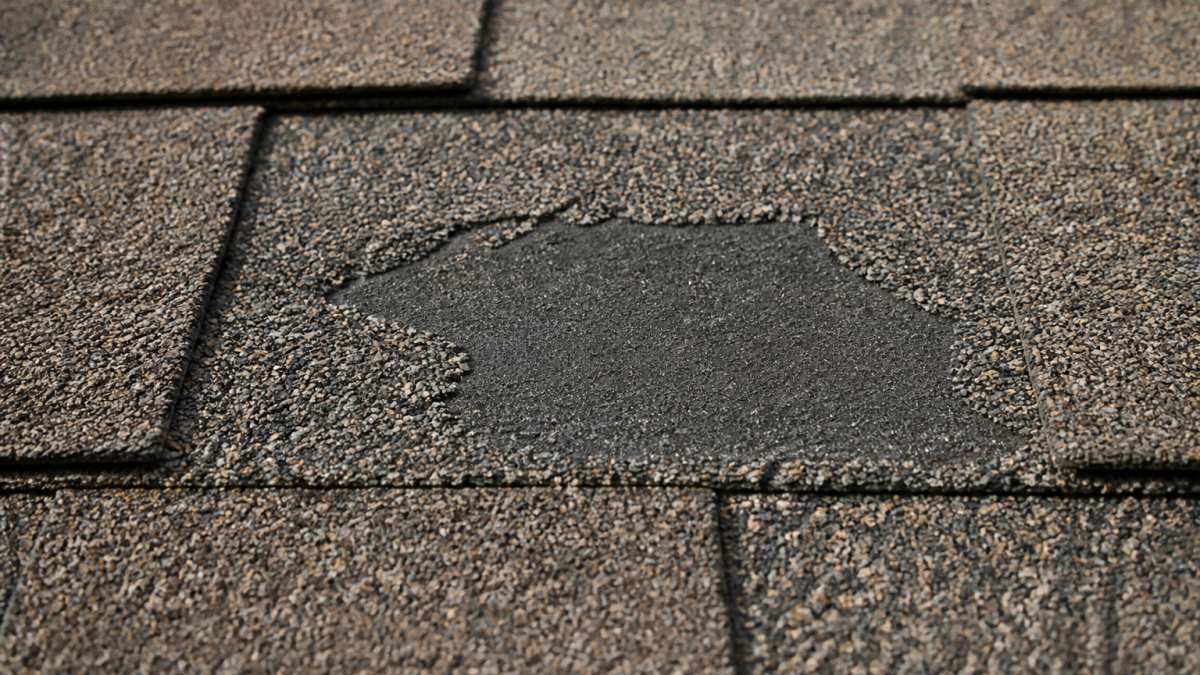
Early granule loss shows up as small changes in the shingle surface. You are looking for spots where the rough, grainy texture has worn smooth.
Shiny Patches and Exposed Asphalt
Shiny patches are the clearest early clue. When granules wear away, the black asphalt underneath shows through.
The fiberglass mat is the next layer down. Once granules and asphalt are gone, the mat and its fiberglass threads can show. That is a late-stage sign, not an early one.
Faded, Uneven Shingle Color
Uneven color is another warning. Faded shingles often signal sun exposure and normal weathering. But patchy, localized fading points to something more specific, like storm damage or a defect in that area.
If one slope looks washed out and the rest looks fine, note it. For a fuller list of warning signs, see our guide on how to tell if your roof needs maintenance.
Finding Granules in Gutters and Downspouts
Granules in gutters are one of the easiest signs to confirm. Rain washes loose granules off the roof and into the gutters. A small amount is normal.
Check the downspout splash area after a rain for a grit trail on the concrete or landscaping.
Compare what you find:
| What You See | What It Likely Means | What to Do |
|---|---|---|
| A light sprinkle of grit | Normal aging | Recheck in a few months |
| Heavy grit after one storm | Possible storm damage | Document and call a pro |
| Grit plus shingle pieces | Active shingle failure | Get an inspection now |
| Grit plus dark stains | Wear plus algae | Clean and inspect |
Clogged gutters make everything worse. Our guide on preventing water damage from clogged gutters covers the fix in detail.
Bald Spots on Asphalt Shingles: When Loss Becomes a Problem
Bald spots on asphalt shingles mean the protective coating is gone in that area. The shingle is now exposed to UV light and rain with no defense, and loss moves from cosmetic to structural.
Watch for these problem signs:
- Bare spots larger than a hand
- Exposed asphalt that stays dark after rain
- Curling edges or clawing at the corners
Localized loss is often storm-related. Uniform loss across the whole roof is usually normal weathering. The difference matters when you talk to a contractor or your insurer.
A balding roof does not always mean replacement. Shingle deterioration can sometimes be slowed with treatment.
Common Causes of Shingle Granule Loss
Most granule loss traces back to storms or time. Sorting out which one applies to your roof changes what you do next.
Storm, Hail, and Wind Damage
Hail damage leaves dents and bruises where granules were knocked loose. Wind damage scours granules off the edges and ridges first. Heavy rain can wash away granules that were already loose.
Signs of storm damage include:
- Loss concentrated on one slope or side
- Bruised spots that feel soft to the touch
- Granules piled at the base of a wall
Document storm damage the same week it happens. Fresh evidence is stronger evidence.
Age and Normal Weathering
Age is the other big factor. Asphalt shingles shed granules slowly over their whole lifespan. InterNACHI's guide to asphalt shingle inspections notes that uniform granule loss is usually normal weathering, not a defect.
Sun exposure and UV light break down the asphalt binder over time. That is why south- and west-facing slopes often wear first. Premature wear, though, points to a problem: poor ventilation, bad installation, or repeated storm exposure.
How to Tell Granule Loss Apart From Algae and Staining
Not every dark mark is granule loss. Algae, staining, and harmless debris fool a lot of homeowners. Get this wrong and you may replace a roof that only needed a cleaning, or ignore real wear because it looked like a stain.
The Three-Question Test
Run every suspicious spot through these three questions in order. Most false alarms fail at question one or two.
- Does it rinse? Spray the area lightly with a garden hose from a safe position, or watch it during the next rain. Debris and manufacturing residue wash away. Algae, staining, and granule loss do not.
- Does it feel grainy or smooth? From a safe reach, run your fingers over the spot. A healthy or algae-covered shingle still feels like coarse sandpaper. A bare patch feels smooth, like worn asphalt or slick fiberglass.
- Does it follow the water or ignore it? Algae streaks run vertically down the slope, following the path water takes. Granule loss forms patches that ignore water flow and cluster where sun, wind, or foot traffic hit hardest.
Side-by-Side Comparison
| Condition | Color and Pattern | Texture | Behavior Over Time | What It Means |
|---|---|---|---|---|
| Granule loss | Dark, shiny, or gray patches; uneven | Smooth, slick | Grows slowly; worsens after storms | Exposed asphalt; monitor or inspect |
| Algae | Dark streaks running vertically down the slope | Still grainy | Spreads downward over years | Cosmetic; clean if desired |
| Staining | Rust, brown, or black blotches near metal or trees | Grainy underneath | Stable unless the source persists | Find and fix the source |
| Debris | Leaves, dirt, grit on the surface | Loose material | Rinses away | Harmless; clean gutters |
| Manufacturing residue | Loose grit on a new roof | Loose, sandy | Clears after a few rains | Normal; no action |
Telling Granules Apart From Dirt and Residue
Granules are the mineral coating baked onto the shingle at the factory. They feel like coarse sand or fine gravel, and they are heavy enough to settle in gutters rather than blow away. Dirt and manufacturing residue are lighter and more uniform.
A useful field test is to compare debris from two roof areas. Scoop a handful from a gutter under a slope that looks healthy and another from a gutter under a slope that looks worn. If the worn slope's gutter holds noticeably more grit, or grit mixed with shingle fragments, that points to real granule loss rather than ordinary dirt.
What to Document After a Storm for Insurance or a Contractor
Good documentation decides whether a claim goes smoothly. Photograph everything before you clean up or repair anything.
Capture these shots:
- Wide shots of each roof slope from the ground
- Close-ups of bare spots and bruised shingles
- Granule piles in gutters and at downspout outlets
Write down the storm date and keep any receipts. If you plan to file a claim, our walkthrough on filing roof insurance claims lays out the steps in order.
One more note: do not sign anything from a door-knocking contractor before your own inspection. Get an independent read first.
Book a Free Roof Inspection With FRESH TEC LLC
A ground-level check tells you a lot, but it cannot tell you everything. Some granule loss is normal.
FRESH TEC LLC is a local, veteran-owned business serving homeowners, realtors, and property managers in Albuquerque and Rio Rancho.
Then book a free inspection with FRESH TEC LLC and get a clear read on your roof before small wear turns into a big bill.
Frequently Asked Questions
What does granule loss on roof shingles look like?
Granule loss shows up as dark, shiny, or bare patches on the shingle surface where the protective coating has worn away, exposing the asphalt beneath. You may also see a gritty, sand-like buildup of granules in gutters and at the base of downspouts. Faded or uneven color across the roof and curling edges are other visual cues. The key is whether the loss is uniform across the whole roof or concentrated in localized spots, which can point to storm damage rather than normal weathering.
Why are granules collecting in my gutters?
Granules in gutters are one of the most reliable early signs of shingle wear. Asphalt shingles shed granules naturally as they age, and heavy rain washes them into the gutter system. A small amount after a storm is normal. A steady accumulation, or granules mixed with visible bald spots on the shingles above, suggests premature wear. Clean the gutters and note the volume, then check the roof surface for matching bare patches before deciding on repairs.
How do I inspect shingles for granule loss without walking on the roof?
Stay on the ground and use binoculars to scan the roof from several angles, looking for shiny patches, bald spots, and uneven color. Check gutters and downspouts for granule buildup after rain. Use a camera with zoom or a drone if you need a closer look. Never climb onto a steep or wet roof. If you spot localized loss, storm damage, or widespread bare areas, call a professional for a safe assessment rather than risking a fall.
Can a roof be repaired if shingles are losing granules?
It depends on the severity and cause. Uniform granule loss from normal aging is often manageable, and a professional assessment can confirm whether the shingle mat is still sound. Localized loss from storm damage may need targeted repair. Widespread bald spots, exposed fiberglass mat, or curling edges usually point to shingle deterioration that warrants replacement. A roof inspection for granule loss will tell you which path fits your roof, and options like FRESH ROOF TREATMENT can extend shingle life before replacement becomes necessary.