 Comparison
Which Roofing Material Handles Albuquerque's High Desert Best?
Last Updated: November 14, 2026
Quick Summary
Standing seam metal is the best-performing choice among roofing materials for Albuquerque's high desert, lasting longest and shedding wind-driven monsoon rain through few penetrations. Clay or concrete tile also resists UV well but requires a structural weight check. Asphalt shingles cost least upfront yet age fastest under intense sun.
- Standing seam metal has the longest service life and needs only annual seam and fastener inspections.
- Tile is heavy, so confirm your frame can carry the load before installing it.
- Asphalt shingles carry the lowest upfront cost but degrade fastest under desert UV.
- TPO membrane suits flat roofs, and reflective coatings extend sound but weathered flat roofs.
- Replacement timing should follow roof condition, not a calendar.
Table of Contents
- Why Albuquerque's High Desert Climate Tests Every Roof
- Roofing Materials for Desert Climates: How the Main Options Compare
- Cool Roof Materials for Hot Climates: Reflectance That Lowers Cooling Load
- Flat Roof Materials for Albuquerque Homes
- Roof Structure, Slope, and Weight: What Your Home Can Carry
- Roof Maintenance After Monsoon Storms
- Lifespan, Installed Cost, and Long-Term Value Compared
- Book a Free Roof Inspection Before You Choose
- Frequently Asked Questions
Why Albuquerque's High Desert Climate Tests Every Roof
Albuquerque's high-desert conditions punish a roof in ways coastal or humid-climate guides never address. Intense UV exposure breaks down asphalt binders, temperature swings from freezing nights to hot afternoons expand and contract every fastener, and monsoon storms drive rain sideways into seams. Elevation adds another layer: thinner air lets more ultraviolet radiation through.
That is why choosing among best roofing materials for Albuquerque high desert climate options is not a style decision. It is a durability decision.
Below, we break down how metal, tile, asphalt, and flat-roof systems hold up in this climate and how to tell which one your home can carry.
Roofing Materials for Desert Climates: How the Main Options Compare
Roofing materials for desert climates fall into four practical families: metal, tile, asphalt shingle, and membrane or coating systems for flat roofs. Each handles sun, wind, and monsoon rain differently, and each fits a different roof structure.
A New Mexico roofing materials guide from ACS Roofing notes that material suitability depends on roof configuration, not a single universal winner. That matches what we see in the field: the right answer changes with slope, weight capacity, and budget.
Standing Seam Metal: Durability and Energy Performance
Standing seam metal is the longest-lived option for pitched roofs in this climate. Raised seams join the panels, so there are far fewer penetrations for wind-driven rain to exploit. Standing seam metal is generally regarded as durable and fire-resistant.
Reflective metal with a cool coating also reduces heat absorption, which eases cooling load in summer.
Best for: homeowners planning to stay long-term and willing to pay more upfront. Skip if: your roof structure or budget cannot support the higher installed cost.
Clay and Concrete Tile in Intense Sun
Tile is the material most people picture on Southwestern homes. Clay and concrete tile are generally considered more resistant to UV degradation than asphalt, and the material does not rot or rust.
The trade-off is weight. Tile is heavy, and not every frame was built for it. Have a professional confirm your structure can carry the load before you commit. Installed costs depend on the project, so ask for a project-specific quote.
Asphalt Shingles: The Lower-Cost Baseline
Asphalt shingles are a common residential roof, largely because of their lower upfront cost. Sun exposure is hard on them in this climate. UV exposure dries out the asphalt binder, and daily thermal expansion works at the seals between shingles.
Replacing a shingle roof that still has life left in it can be unnecessary. If granules are mostly intact and shingles are not curling badly, restoration may extend the roof's service life. For detail on sun damage, see how to protect asphalt shingles from desert sun damage, and for realistic timelines read how long shingles last in New Mexico's sun.
Cool Roof Materials for Hot Climates: Reflectance That Lowers Cooling Load
Cool roof materials for hot climates work by reflecting sunlight instead of absorbing it. Two numbers drive performance: solar reflectance, which measures how much sunlight bounces back, and thermal emittance, which measures how well the surface releases absorbed heat.
Reflective options include cool-rated metal, TPO and PVC membranes, and reflective coatings applied over existing roofs. On a flat roof, a coating can lower surface temperature and reduce the load on your air conditioner. If you are weighing coating types, our comparison of silicone versus elastomeric roof coating in New Mexico covers the differences between them.
Flat Roof Materials for Albuquerque Homes
Flat roof materials for Albuquerque homes center on membrane systems and coatings. TPO membrane is a common choice for flat roofs. TPO is a single-ply membrane that handles standing water and sun exposure well when installed correctly.
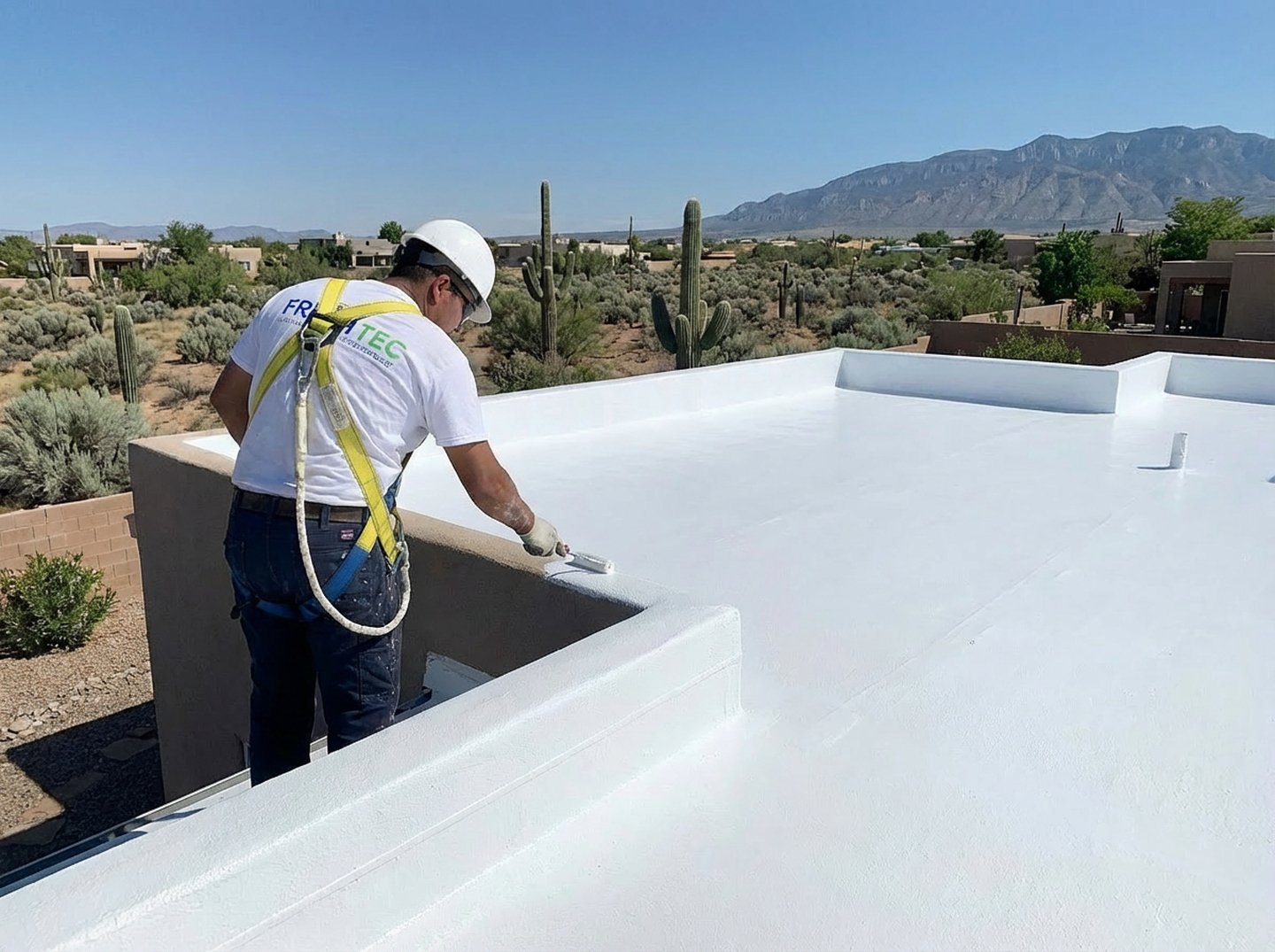
Coating systems can offer a lower-cost path. Our guide to flat roof rejuvenation, coating versus restoration versus replacement explains how to tell the difference.
Roof Structure, Slope, and Weight: What Your Home Can Carry
Roof structure, slope, and weight decide which materials are even possible. Structure, slope, and weight determine which materials are workable. A material can fail early if the roof cannot shed water, carry the load, or breathe.
Slope Decides the System Family
Slope is measured as rise over run and expressed as a ratio. As a working rule, pitched roofs suit shingle, metal, and tile, while low-slope roofs need membrane or coating systems. Practical slope thresholds vary by material, and manufacturer specifications should be consulted for minimum-slope requirements. Flat and low-slope roofs cannot rely on gravity the same way, so they depend on continuous membrane seams and positive drainage to the drains. Putting a steep-slope material on a low-slope roof, or the reverse, can cause costly problems.
Weight and Structure
Tile is heavy, and not every frame was built for it. Clay and concrete tile can require a structural assessment and, in some cases, framing upgrades before installation. Metal and shingles are lighter and usually fit existing framing without reinforcement. The deck condition matters as much as the framing: soft or rotted decking must be repaired before any new layer goes on, because a new roof over a failing deck just hides the problem. Confirm capacity and deck condition first, in writing, before you commit to a heavy material.
Ventilation and Underlayment
Trapped attic heat shortens the life of every material above it. Intake at the eaves and exhaust at the ridge keep attic air moving, which lowers the temperature the roof deck and underlayment see and eases the cooling load in summer. Underlayment is the second line of defense under tile and metal, and its condition often determines whether a leak shows up as a stain or as rotted decking. Ventilation and underlayment are installation details, not material choices, which is exactly why material-only comparisons miss them.
Ratings, Codes, and Insurance
Roof choices also carry code and insurance consequences. Wind, fire, and hail impact ratings are commonly referenced in product listings and can affect insurability and premiums. Local permitting and inspection requirements apply to reroofs, and the specifics depend on the jurisdiction and the scope of work. Ask your contractor which ratings apply to your project and confirm requirements with the local authority before work begins.
Watch out: installing tile over a frame that was never engineered for it can cause sagging and costly structural repairs. Confirm capacity, deck condition, and slope suitability first.
Roof Maintenance After Monsoon Storms
Roof maintenance after monsoon storms is mostly about water and wind, not heat. After each storm season, check for lifted or missing shingles, granule piles in gutters, and standing water on flat roofs. Clear debris from drains so water cannot pool.
Wind-driven rain finds every failed sealant line, so inspect flashing around vents and chimneys. Small repairs caught early stay small. A roof that has taken repeated hail hits deserves a professional look before the next season.
Lifespan, Installed Cost, and Long-Term Value Compared
Lifespan and installed cost rarely point to the same winner, which is why lifecycle thinking matters. Metal and tile cost more upfront but last far longer. Asphalt shingles cost less but age faster under desert sun. Flat membrane systems sit in between. The table below compares the options on the factors that actually drive long-term value, followed by the maintenance and replacement timing that material-only comparisons leave out.
| Material | Relative Upfront Cost | Expected Service Life | Heat and UV Performance | Maintenance Cadence | Storm Resistance | Best Fit |
|---|---|---|---|---|---|---|
| Standing seam metal | High | Longest | Strong, especially with cool coating | Low; annual inspection of seams and fasteners | High; few penetrations, sheds hail and wind-driven rain | Long-term owners, pitched roofs |
| Clay or concrete tile | High | Long | Strong UV resistance, heavy | Low to moderate; watch for cracked or slipped tiles after hail | Good, but brittle under impact | Homes built for tile weight |
| Asphalt shingles | Lowest | Shorter in desert sun | Moderate, degrades under UV | Moderate; granule loss and seal checks each season | Moderate; wind and hail lift seals | Budget-focused replacements |
| TPO membrane | Mid to high | Long with care | Good reflectivity | Moderate; seam and drain checks, ponding watch | Good when seams are welded correctly | Flat roofs |
| Reflective coating | Lowest | Extends existing roof | Improves reflectance | Moderate; recoat on a schedule as reflectance fades | Low on its own; depends on the membrane below | Sound but weathered flat roofs |
What Drives the Real Installed Cost
Installed cost is not the material price alone. The number a homeowner actually pays is built from the material, the tear-off and disposal of the old roof, decking repair, underlayment and flashing, ventilation work, and labor for the roof's slope and complexity. A simple pitched roof and a cut-up roof with valleys, dormers, and multiple penetrations can carry very different labor totals for the same material. Tile adds a structural review and possible framing work; flat systems add insulation and drainage detailing.
Maintenance and Replacement Timing
In this climate, the cheapest roof is not always the cheapest to own. Asphalt shingles need granule and seal attention after each monsoon and hail season, and their service life shortens under intense UV.
Replacement timing should be driven by condition, not by a calendar. If the underlayment is failing, the deck is soft, or leaks recur in the same spot, patching is throwing money at a roof that is done.
Watch out: comparing bids on the headline number alone hides differences in tear-off, decking repair, and underlayment, which are where cheap quotes quietly cut corners and where long-term value is won or lost.
Book a Free Roof Inspection Before You Choose
The right material choice starts with knowing what your roof can actually support and what condition it is in now. A thorough inspection checks decking, flashing, underlayment, ventilation, and shingle condition, then maps those findings to your real options. Our guide on what a roof inspection checks shows the full checklist.
Realtors and property managers trust us to get exteriors show-ready. If you are weighing restoration against replacement, an inspection can help you decide.
Choosing a roof in this climate comes down to matching material to structure, slope, and budget, then protecting whatever you install.
Frequently Asked Questions
What is the best roofing material for a high-desert climate?
There is no single best answer because roof slope, structure, and budget decide it. Standing seam metal and clay or concrete tile are generally regarded as handling intense UV and temperature swings well, while TPO membrane is a common choice for flat roofs. Asphalt shingles remain the lower-cost baseline and can be extended with rejuvenation treatment. Match the material to your roof configuration first, then compare lifespan and installed cost.
What is the best roof material for cooling in hot climates?
Reflective options perform best. Cool roof materials for hot climates include TPO, PVC, and cool-roof coatings, which reduce heat absorption. Metal roofing with a reflective or cool coating and asphalt shingles with reflective granules also help. Solar reflectance and thermal emittance are the two numbers that matter, so ask for both when comparing products.
How do asphalt shingles, metal, and tile compare for durability?
Metal and tile generally outlast asphalt shingles, and standing seam metal is generally regarded as fire-resistant. Asphalt shingles cost less upfront but age faster under UV exposure and temperature swings. That gap is why shingle rejuvenation, which extends shingle life by 6-8 years, is worth comparing against replacement when the roof is still structurally sound.
How often should a roof be inspected in a high-desert climate?
Inspect at least once a year and again after every monsoon season. Albuquerque's UV exposure, extreme heat, and wind-driven rain stress flashing, seals, and underlayment. Walk the roof after major storms to check for lifted or missing shingles, granule loss, and ponding on flat sections. Catching small repairs early is far cheaper than replacing decking or membrane later.